Advertisement
Kenya’s inflation hits 4.1% in July, driven by food and fuel costs
Friday 01st August, 2025 07:47 PM|

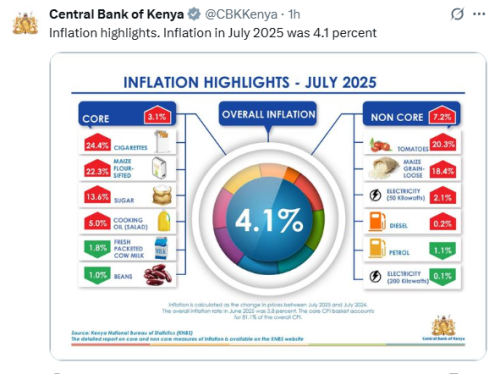
Kenya’s year-on-year inflation rate rose to 4.1 per cent in July 2025, up from 3.8 per cent in June, according to data released by the Kenya National Bureau of Statistics (KNBS) and the Central Bank of Kenya (CBK).
This marks the highest rate since April and signals growing pressure on household budgets.
The inflation rate is calculated by comparing changes in the Consumer Price Index (CPI) between July 2025 and July 2024. The uptick was largely driven by a combination of soaring food prices and energy costs, reflecting both core and non-core inflation components.
Core inflation, which excludes volatile items such as food and fuel, stood at 3.1 per cent. Within this category, the biggest contributors were:
- Cigarettes (24.4 per cent)
- Maize flour (sifted) (22.3 per cent)
- Sugar (13.6 per cent)
- Cooking oil (salad) (5.0 per cent)
- Fresh packeted cow milk (1.8 per cent)
- Beans (1.0 per cent)
You Might Also Like



Although core inflation appears stable, the rise in everyday staples like sugar and maize flour continues to strain household purchasing power, especially for low- and middle-income families. These items are part of the core CPI basket, which accounts for 81.1 per cent of the overall CPI.
PHOTO/Screengrab by People Daily Digital
Food and fuel prices surge
Non-core inflation, which includes foodstuffs and energy, was notably higher at 7.2 per cent. Key contributors included:
- Tomatoes (20.3 per cent)
- Maize grain (loose) (18.4 per cent)
- Electricity (50 kWh) (2.1 per cent)
- Petrol (1.1 per cent)
- Diesel (0.2 per cent)
- Electricity (200 kWh) (0.1 per cent)
These spikes come just a month after the KNBS June report showed a sharp increase in prices of carrots, cabbages, and sugar, along with modest rises in spinach, maize flour, and beef with bones. In contrast, some relief came from price dips in cooking oil, potatoes, and milk, which helped temper overall inflation in June.
The July figures indicate a persistent upward trend in consumer prices, despite earlier Central Bank efforts to contain inflation, including a reduction in the base interest rate to 10.0 per cent in April. While exports and tourism have shown resilience, the rising cost of essentials may dampen economic optimism.
Author
Kenneth Mwenda
Kenneth Mwenda is a business, sports, and politics digital writer with over seven years of experience in journalism, covering breaking news, feature stories, and in-depth analysis across a range of beats.
For inquiries, he can be reached at [email protected]
View all posts by Kenneth MwendaLatest News








Advertisement
More on Business