Advertisement
McOure praises Ruto’s compensation plan for victims of rights abuses
Thursday 25th June, 2026 11:49 PM|

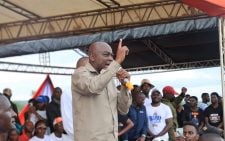
Prominent ODM youth leader Kasmuel McOure has welcomed President William Ruto’s government initiative to compensate victims of human rights violations linked to past protests, describing it as a key step toward accountability and national healing.
Speaking during an interview on June 25, 2026, marking the anniversary of the 2024 anti-government demonstrations, McOure said the move reflects progress on long-standing demands raised during street protests. He noted that his activism had centred on ending police brutality and securing recognition for victims of state violence.
Compensation framework
The Kenya National Commission on Human Rights (KNCHR) was issued a 60-day mandate by Ruto to design a reparations framework addressing victims of gross human rights violations.
Kenya National Commission on Human Rights subsequently developed a structured compensation plan, leading to the gazettement of 2 billion shillings for implementation. Initial disbursements amounting to 448 million shillings have already reached 348 victims under the programme.
You Might Also Like

The graduated compensation scheme provides Ksh3 million for fatalities, Ksh1 million for major injuries or aggravated sexual violence, Ksh500,000 for moderate injuries, and Ksh50,000 for minor injuries, alongside support for documented economic losses. McOure emphasised that the payments are intended as recognition of harm rather than valuation of life.
Ruto, while receiving the KNCHR report at State House on June 15, 2026, stated: “These payments are not the price of life, pain or loss and neither are they a reward for violence, looting or unlawful conduct,” adding that compensation reflects state acknowledgement that “harm occurred, victims matter and that a nation heals by tending to its wounds rather than pretending they do not exist.”
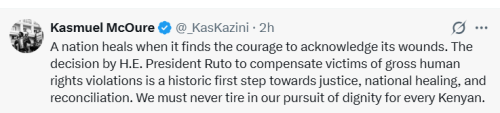
He further clarified that “Neither should it be understood as a licence for disorder. Let no one confuse compensation and impunity.” KNCHR Chairperson Claris Ogangah stated that eligibility is limited to victims of extrajudicial killings, enforced disappearances, torture, excessive force, and sexual violence linked to state actions between 2013 and 2025.
Reactions, accountability, and broader implications
McOure contrasted the current approach with earlier post-election violence compensation efforts, describing the new framework as more structured and proactive.
He also referenced personal experiences of being shot at during protests and displacement during earlier unrest, while noting that victims remain free to pursue criminal or civil action despite receiving compensation.
He further raised concerns about political narratives during commemorations, questioning the participation of leaders who did not previously address cases such as Baby Pendo.
The programme marks one of the first structured state-led reparations initiatives for protest-related abuses in Kenya. Authorities maintain that the process is intended to promote accountability while reinforcing that criminal liability for unlawful conduct remains separate from compensation mechanisms.
McOure stated that while progress is evident, sustained reforms will be necessary to address ongoing concerns around policing and public order management.
Author
Latest News



Advertisement
More on Inside Politics