Advertisement
EAC tables Ksh14.4B budget for 2026/2027 financial year
Thursday 25th June, 2026 10:55 AM|
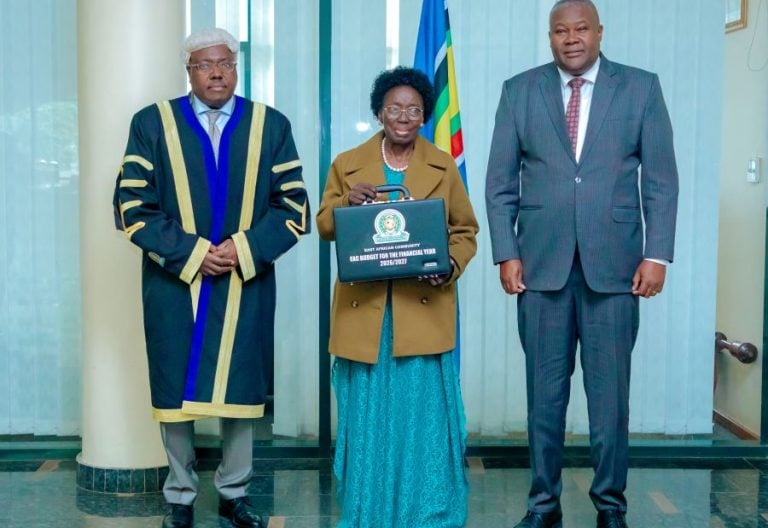
The East African Community (EAC) has tabled a budget of $110.9 million, about Ksh14.4 billion, before the East African Legislative Assembly (EALA) for the 2026/2027 financial year.
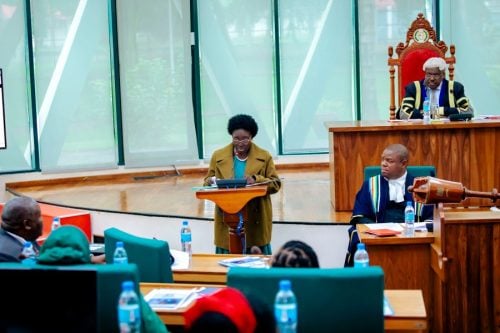
The budget was presented on Tuesday evening, June 23, 2026, at the EAC Headquarters in Arusha, Tanzania, by Uganda’s minister for East African Community Affairs and Chairperson of the EAC Council of Ministers, Rebecca Alitwala Kadaga.
The new budget marks the start of the Seventh EAC Development Strategy covering 2026/27 to 2030/31. The strategy carries the theme: “Deepening Commitment and Realising Objectives and Benefits of Regional Integration”.
The East African Community said the budget introduces a new financing framework aimed at strengthening ownership by partner states, improving sustainability and speeding up implementation of regional programmes.
EAC economy records strong growth
You Might Also Like



While presenting the estimates to EALA, Kadaga said the region recorded strong economic growth despite global economic uncertainty.
According to the EAC, the regional economy expanded by 5.8 per cent in 2025. The figure was higher than the global average of 3.4 per cent and Sub-Saharan Africa’s average growth of 4.5 per cent.
Intra-EAC trade also rose sharply by 28 per cent to $19.3 billion, approximately Ksh2.5 trillion. Trade between EAC partner states and the rest of the world increased by 25.4 per cent to $156.6 billion, about Ksh20.3 trillion.
Regional exports grew by 37.5 per cent, helping reduce the EAC trade deficit from $13 billion in 2024 to $2.6 billion in 2025.
“East Africans reached out to one another increasingly in terms of cross-border trade, farmers reached new markets, manufacturers expanded production, transporters moved more goods faster, and young entrepreneurs found opportunities beyond national borders,” Kadaga told the Assembly.
The EAC also resolved 35 Non-Tariff Barriers (NTBs) during the financial year and launched the EAC Customs Bond, a regional digital guarantee scheme that allows goods to move across borders under a single financial security arrangement.
Focus on trade, infrastructure and integration
The 2026/2027 EAC budget prioritises regional trade, industrialisation, infrastructure development, peace and security, and institutional strengthening.
The community has allocated $11.1 million, about Ksh1.4 billion, towards promoting inter and intra-regional trade through value chains and legal reforms.
Another $7.2 million, around Ksh936 million, will support industrial development, production and value addition in key sectors.
Social integration programmes will receive $10.7 million, equivalent to about Ksh1.39 billion.
The EAC has also allocated $4.1 million for implementation of the East African Monetary Union roadmap, including harmonisation of fiscal and monetary policies and operationalisation of the East African Monetary Institute (EAMI).
Regional infrastructure projects will receive $4 million, while governance, peace and security programmes will take $3.4 million.
The largest share of the budget, $70.5 million or about Ksh9.2 billion, has been allocated to institutional capacity building and service delivery across EAC organs and institutions.
Kadaga said the Community made major progress on infrastructure projects during the 2025/2026 financial year.
She noted that construction of the East African Crude Oil Pipeline (EACOP) had passed 80 per cent completion.
The EAC also advanced regional road projects, supported the Standard Gauge Railway network and completed designs for strategic One Stop Border Posts.
The bloc further secured financing for feasibility studies on the 39MW Nsongezi Hydropower Project along the Uganda-Tanzania border.
On Lake Victoria, the Community strengthened maritime safety by commissioning the Regional Maritime Rescue Coordination Centre in Mwanza and deploying rescue vessels.
“For fishermen, traders and families who depend on the waters of Lake Victoria, these investments represent something priceless: safety, confidence and hope,” Kadaga said.
Health and technology programmes expanded
The EAC said regional cooperation continued to improve healthcare services across member states.
Nine EAC Centres of Excellence in Biomedical Sciences trained 785 postgraduate students and more than 3,300 health professionals during the year.
The centres also provided specialised treatment to over 12,500 patients, including kidney transplants and cancer care.
The Community deployed mobile laboratories and testing kits to support partner states during Ebola and Mpox outbreaks.
“Perhaps few achievements illustrate the power of regional cooperation better than those recorded in the health sector,” Kadaga said.
The EAC also expanded support for science, technology and innovation.
According to Kadaga, the Community supported 16 youth innovators with grants and training to help them turn Artificial Intelligence solutions into commercially viable products and services.
“This initiative will accelerate AI-driven entrepreneurship, create jobs, attract investment and enhance the region’s digital competitiveness and socio-economic development,” she said.
The region also continued implementation of the Eastern Africa Regional Digital Integration Project (EARDIP), which aims to expand affordable broadband connectivity, improve cross-border digital services and build the EAC Single Digital Market.
The Community intensified efforts to market East Africa as one tourism destination under the regional tourism brand “Visit East Africa – Feel the Vibe.”
“We do not speak as individual countries; we speak with one voice. And the world is listening,” Kadaga remarked.
On political integration and regional stability, the EAC resumed national consultations on the drafting of the Constitution for the East African Political Confederation.
The bloc also supported peace initiatives in eastern Democratic Republic of Congo, deployed election observer missions and conducted the 14th EAC Armed Forces Command Post Exercise known as Ushirikiano Imara.
In Rwanda, the EAC carried out the Fifth Civil-Military Cooperation Week, where more than 1,000 residents received medical treatment while vulnerable households received solar installations and access to clean water.
EALA to debate budget
The budget will now be debated and considered by the East African Legislative Assembly before approval.
The EAC Secretariat received the largest allocation at $59.8 million, about Ksh7.8 billion, followed by EALA at $19.2 million, approximately Ksh2.5 billion.
Other allocations include $5 million for the East African Court of Justice, $9.3 million for the Inter-University Council for East Africa and $7 million for the Lake Victoria Basin Commission.
Kadaga congratulated the newly appointed EAC Secretary General, Amb. Stephen Patrick Mbundi, saying the Council was ready to work with him in implementing the seventh EAC Development Strategy.
She also praised outgoing Secretary General Veronica Mueni Nduva for her leadership and commitment to regional integration.
“The East African Community remains steadfast in its pursuit of deeper regional integration, fostering sustainable economic growth, social development, regional stability and institutional effectiveness to deliver tangible benefits and shared prosperity for all East Africans,” Kadaga said.
Author
Kenneth Mwenda
Kenneth Mwenda is a business, sports, and politics digital writer with over seven years of experience in journalism, covering breaking news, feature stories, and in-depth analysis across a range of beats.
For inquiries, he can be reached at [email protected]
View all posts by Kenneth MwendaLatest News


Advertisement
More on Business