Advertisement
Why Treasury is centralising county funds under one account system
Monday 15th June, 2026 10:51 AM|

Kenya’s county governments will receive a record Ksh502 billion in the 2026/27 financial year, even as the National Treasury prepares a major shift in how the funds are managed through the rollout of a Treasury Single Account (TSA) system.
Treasury Cabinet Secretary John Mbadi announced the allocation during his budget statement to the National Assembly on June 11, 2026, describing it as part of ongoing reforms aimed at strengthening devolution while addressing long-standing inefficiencies in county public finance management.
At the centre of the new budget framework is not just the size of the allocation but the structure of control – moving counties away from fragmented banking systems toward a centralised cash management model.
County allocation breakdown (2026/27)
The total county allocation is composed of three main funding streams. These include the equitable share, conditional transfers, and development partner support. Together, they form the full transfer envelope of Ksh502 billion.
| Component | Amount (Ksh billion) | Description |
|---|---|---|
| Equitable share | 428.0 | Direct constitutional allocation to counties following Senate–National Assembly agreement |
| Loans & grants | 57.4 | Development partner support for county-level projects and programmes |
| National government share | 16.6 | Conditional allocations tied to specific national priorities |
| Total County Allocation | 502.0 | Overall transfer to county governments |
Top county allocations
You Might Also Like


The distribution of funds remains weighted toward larger populations and economic hubs, with Nairobi retaining the highest allocation, followed by key regional counties.
| County | Allocation (Ksh billion) |
|---|---|
| Nairobi City | 22.1 |
| Nakuru | 14.9 |
| Turkana | 14.3 |
| Kakamega | 14.1 |
| Kiambu | 13.5 |
| Kilifi | 13.2 |
Growth in county funding over time
County allocations have steadily increased over the years, reflecting both inflationary adjustments and the government’s expanding commitment to devolution. The rise between the 2022/23 financial year and the 2026/27 financial year highlights the growing fiscal responsibility that counties now carry within Kenya’s national budget framework.
In 2022/23, the equitable share stood at Ksh370 billion, with total county allocations amounting to Ksh392.4 billion. By 2026/27, this figure is projected to rise significantly to Ksh428 billion for the equitable share and Ksh502 billion in total allocations.
“Since 2022, funding to county governments has steadily increased, with the equitable share to counties increasing from Ksh370.0 billion in the FY 2022/23 budget to Ksh428.0 billion in the FY 2026/27 budget,” Mbadi said.
“Total county allocations that include shareable revenue and additional allocations from the national government allocations, as well as donor proceeds, have therefore increased from Ksh392.4 billion to Ksh502.0 billion over the same period.”
Treasury Cabinet Secretary John Mbadi said the upward trend reflects deliberate efforts to deepen devolution and improve service delivery at the county level, even as concerns remain over financial management discipline and spending efficiency across devolved units.

Single account to replace fragmented systems
Beyond the funding increase, the most significant reform in the 2026/27 budget is the planned extension of the Treasury Single Account (TSA) to all 47 counties beginning July 1, 2026.
The reform will require counties to shift from multiple commercial bank accounts to a centralised system, similar to the national government model already operating through the Central Bank of Kenya.
The shift represents a structural redesign of how counties receive, hold, and spend public funds. The comparison below highlights the expected change in financial operations.
| Current System | TSA System (From July 2026) |
|---|---|
| Multiple county bank accounts | One consolidated treasury account |
| Manual and fragmented approvals | Automated payments tied to verified invoices |
| Weak cash visibility across departments | Real-time centralised cash monitoring |
| Delayed and inconsistent supplier payments | Faster, rule-based disbursement system |
| High discretion in payment prioritisation | Reduced human interference and favoritism |
The Treasury argues that fragmented banking arrangements have contributed to inefficiency, weak oversight, and growing arrears across counties.
Controller of Budget Margaret Nyakang’o has repeatedly raised concerns over the accumulation of unpaid bills, noting that counties had built up Ksh183 billion in pending obligations as of June 2025, with suppliers often waiting extended periods for payment.
Earlier financial reviews have also shown rapid accumulation of arrears within short timeframes, highlighting deeper cash management weaknesses within devolved units.
Lessons from the National TSA System
The national government’s existing Treasury Single Account (TSA) is being used as the reference model for the planned rollout to counties, offering a benchmark for how centralised cash management can improve efficiency and oversight.
Key performance outcomes from the national system include a 61 per cent reduction in overdraft costs, improved real-time cash visibility, tighter payment control through direct linkage to verified invoices, and reduced reliance on emergency borrowing. These gains are being cited by the Treasury as evidence that a unified account structure can strengthen fiscal discipline across government.
As Treasury Cabinet Secretary John Mbadi noted:
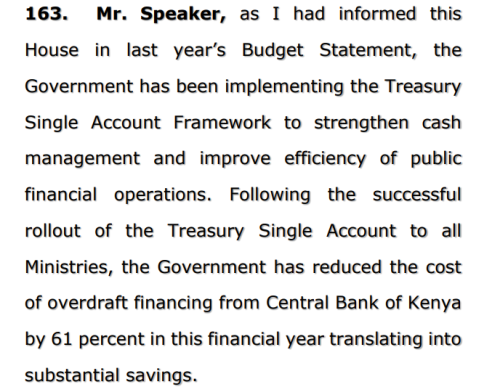
“Mr. Speaker, as I had informed this House in last year’s Budget Statement, the Government has been implementing the Treasury Single Account Framework to strengthen cash management and improve efficiency of public financial operations.”
“Following the successful rollout of the Treasury Single Account to all ministries, the government has reduced the cost of overdraft financing from the Central Bank of Kenya by 61 per cent in this financial year, translating into substantial savings.”
The transition to a single account system is expected to have wide-ranging implications for suppliers, contractors, and households that rely on county-level services and payments.
Contractors and suppliers are likely to benefit from faster and more predictable payments, while small businesses could experience improved cash flow stability. In public procurement, the system is expected to reduce discretionary payment decisions, and for citizens, it may translate into more consistent delivery of essential services such as health, water, and infrastructure.
Treasury maintains that under the new framework, payments will only be processed against verified obligations. This is intended to reduce duplication, eliminate fictitious claims, and minimise politically influenced payment queues that have previously contributed to delays and inefficiencies.
Additional budget support for Counties
Beyond equitable share allocations, counties will also receive targeted support through national programmes designed to strengthen institutional capacity and address regional disparities.
This includes funding for the Equalisation Fund (Ksh10.3 billion) aimed at supporting marginalised regions, the Kenya Devolution Support Programme II (Ksh10.5 billion) focused on institutional strengthening, and additional county infrastructure support covering ICT systems, headquarters development, and connectivity upgrades.
Counties will also continue implementing national programmes such as climate action initiatives spanning 1,380 wards and the NYOTA youth employment programme, which has already created over 51,000 job placements across the country.
Despite rising allocations, counties continue to face structural fiscal constraints that undermine service delivery efficiency. These include high wage and administrative costs that consume large portions of budgets, slow clearance of pending bills that strain supplier relationships, and weak absorption of development funds that limits long-term investment impact.
The Intergovernmental Budget and Economic Council has already approved corrective action plans requiring counties to strengthen financial discipline in preparation for the TSA rollout, with emphasis on accountability and timely payment systems.
Author
Kenneth Mwenda
Kenneth Mwenda is a business, sports, and politics digital writer with over seven years of experience in journalism, covering breaking news, feature stories, and in-depth analysis across a range of beats.
For inquiries, he can be reached at [email protected]
View all posts by Kenneth MwendaLatest News







Advertisement
More on Business