Advertisement
KeNHA reveals toll fee motorists will pay to use Gilgil-Nakuru-Mau Summit road
Tuesday 07th July, 2026 03:00 PM|
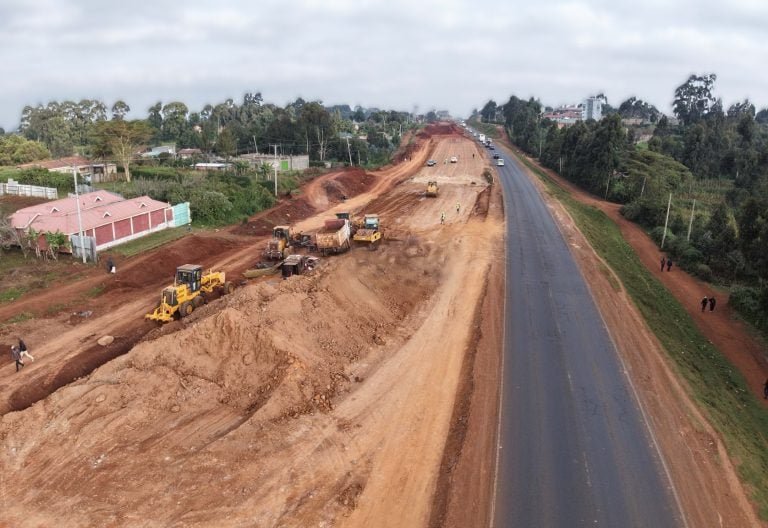
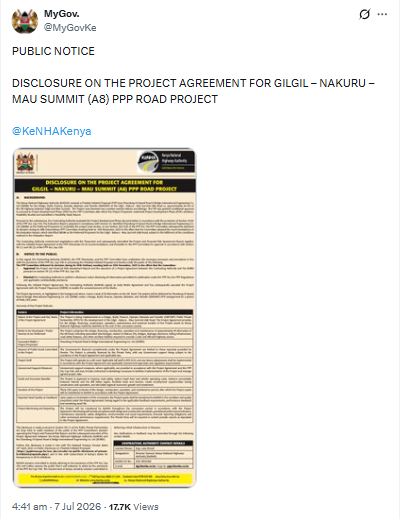
Motorists will pay Ksh8.50 per kilometre to use the new Gilgil-Nakuru-Mau Summit road once the project is completed, following the signing of a 30-year public-private partnership agreement between the Kenya National Highways Authority (KeNHA) and China’s Shandong Hi-Speed Road & Bridge International Engineering Co. Ltd (SDRBI).
The toll charges were disclosed by KeNHA in a public notice published on Tuesday, July 7, 2026, outlining the project agreement for the 94-kilometre section of the A8 highway.
The Gilgil-Nakuru-Mau Summit road forms part of the wider upgrade of the busy Nairobi-Rift Valley corridor, one of Kenya’s most important transport routes for passengers and cargo.
According to KeNHA, motorists will pay Ksh8.50 per kilometre, meaning a driver travelling the entire 94-kilometre stretch would pay about Ksh799 at the current tariff.
You Might Also Like



“The Project will operate as a toll road. Applicable toll tariff is Ksh8.50, and any future adjustments shall be implemented in accordance with the Project Agreement and applicable Government approvals and regulatory requirements,” KeNHA said.
The authority noted that any future review of the toll charges will require government approval and must follow the terms of the project agreement.
Gilgil-Nakuru-Mau Summit road project
The project covers approximately 94 kilometres of the A8 highway between Gilgil and Mau Summit. The road passes through Nakuru and Baringo counties and will be delivered under a Design, Build, Finance, Operate, Maintain and Transfer (DBFOMT) Public-Private Partnership (PPP) model.
Under this arrangement, SDRBI will design, finance, construct, operate and maintain the highway for 30 years before transferring it back to KeNHA.
The project originated from a Privately Initiated Proposal (PIP) submitted by SDRBI. After feasibility studies, evaluations and approvals under the Public Private Partnerships Act, the PPP Committee approved the project agreement in November 2025.
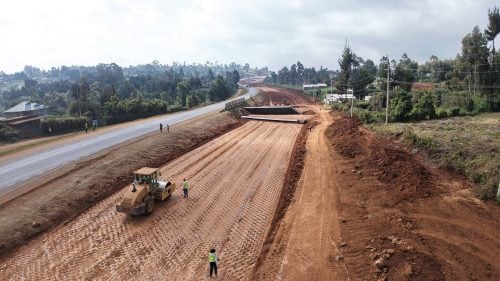
KeNHA said it has already signed an Early Works Agreement before executing the final project agreement, allowing construction to begin.
What the project will include
Besides expanding the highway, the project will include several major infrastructure improvements designed to increase capacity and improve safety.
According to KeNHA, the works will include:
| Feature | Details |
|---|---|
| Road length | 94 kilometres |
| Project model | DBFOMT Public-Private Partnership (PPP) |
| Contractor | Shandong Hi-Speed Road & Bridge International Engineering Co. Ltd (SDRBI) |
| Concession period | 30 years |
| Toll charge | Ksh8.50 per kilometre |
| Major works | Interchanges, Nakuru City viaduct, bridges, drainage systems, toll plazas, road safety infrastructure and ancillary facilities |
| Monitoring | KeNHA throughout the concession period |
| Ownership after concession | Road transferred back to KeNHA |
The authority said the project will include the construction of interchanges, a viaduct in Nakuru City, bridges, drainage structures, toll collection infrastructure and additional road safety features to improve traffic flow along the corridor.
Why KeNHA chose a PPP model
KeNHA said the highway will be financed mainly by the private partner instead of relying entirely on public funds.
Under the DBFOMT model, the private company raises the money required to build the road, operates and maintains it during the concession period and recovers its investment through toll collections before handing the road back to the government.
“The Government’s financial commitments under the Project Agreement are limited to those expressly provided for therein. The Project is primarily financed by the Private Party, with any Government support being subject to the provisions of the Project Agreement and applicable law,” KeNHA said.
Expected benefits of the Gilgil-Nakuru-Mau Summit road
KeNHA expects the project to improve one of Kenya’s busiest transport corridors linking Nairobi with the Rift Valley and western Kenya.
According to the authority, the upgraded highway will:
- Reduce travel time.
- Lower vehicle operating costs.
- Improve road safety.
- Strengthen connectivity between Nairobi and the Rift Valley.
- Support trade and tourism.
- Create jobs during construction and operation.
- Encourage regional investment and economic growth.
The authority also said it will monitor the project throughout the concession period to ensure compliance with engineering standards, environmental requirements, maintenance obligations, safety measures and financial reporting.
Once the 30-year concession ends, SDRBI will hand the road back to KeNHA in the condition required under the project agreement, including meeting the agreed performance standards and remaining asset life requirements.
The Gilgil-Nakuru-Mau Summit road is the second major privately financed section of the A8 corridor after the Rironi-Gilgil and Rironi-Maai Mahiu-Naivasha projects, signalling the government’s continued use of public-private partnerships to expand Kenya’s strategic road network.
Author
Kenneth Mwenda
Kenneth Mwenda is a business, sports, and politics digital writer with over seven years of experience in journalism, covering breaking news, feature stories, and in-depth analysis across a range of beats.
For inquiries, he can be reached at [email protected]
View all posts by Kenneth MwendaLatest News





Advertisement
More on Business