Advertisement
How James Orengo shaped Saba Saba in the 90s and his relentless push in 2026
Tuesday 07th July, 2026 03:57 PM|
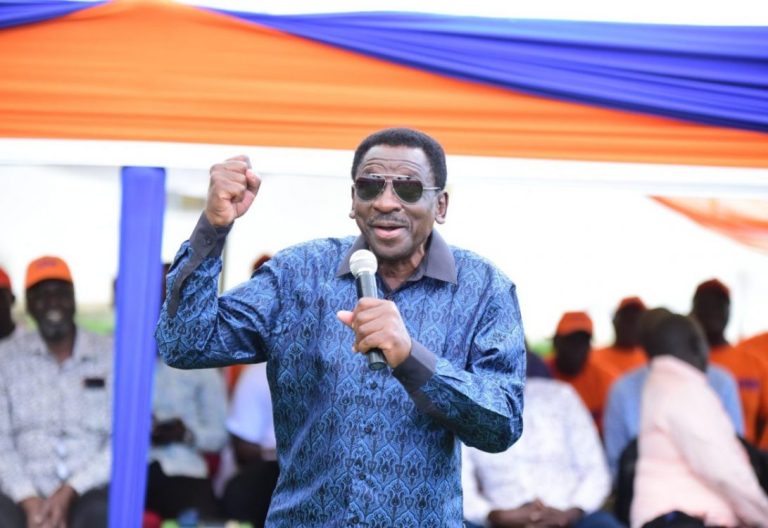
For more than four decades, Siaya Governor James Orengo has remained one of Kenya’s most recognisable voices in the fight for democracy and constitutionalism.
Long before he became governor, Cabinet minister or senator, Orengo was among a group of young lawyers who openly challenged the authoritarian rule of former President Daniel arap Moi. His activism placed him in the path of detention, exile and imprisonment, experiences that shaped his role during the historic Saba Saba protests of July 7, 1990.
Thirty-six years later, on Saba Saba Day in 2026, Orengo says the struggle that began in 1990 is still unfinished.
Before Saba Saba: Exile, chains and prison
Orengo’s reputation as a fearless government critic was established before the Saba Saba movement.
You Might Also Like
After the failed 1982 coup attempt, the Moi regime intensified its crackdown on perceived dissidents and reformists. Fearing arrest, a young James Orengo fled into exile, first to Zimbabwe and then Tanzania. His stay was short-lived.
He was arrested by Tanzanian authorities and handed back to Kenya during a prisoner exchange involving soldiers linked to the failed coup and Tanzanian security personnel.
Years later, Orengo recalled the painful journey.
“I didn’t know that going to Tanzania I would be brought back to Kenya in a plane but in chains. Including my legs were chained, my hands.”
He described the trip from the Namanga border to Naivasha prison as brutal.
“It was a journey to hell. We were beaten and subjected to all manner of abuse. You were expected to keep your head between your legs throughout the entire harrowing journey.”
He was detained in Kamiti Maximum Prison for six months and later Naivasha Prison for another six months, where he at one point shared a cell with Hezekiah Ochuka.
Those experiences hardened his resolve and cemented his place among Kenya’s leading pro-democracy campaigners.
The road to July 7, 1990
By 1990, pressure for political reforms had reached unprecedented levels.
Kenya had been a one-party state since Section 2A of the Constitution was introduced in 1982, making Kenya African National Union, the country’s only legal political party.
Economic hardship, corruption, political repression and demands for greater freedoms fuelled calls for change.
Veteran politicians Kenneth Matiba and Charles Rubia announced plans for a public rally at Kamukunji Grounds on July 7, 1990.
The government banned the gathering before it could take place.
Matiba and Rubia were arrested days before the rally. Other opposition figures, including Raila Odinga, also faced arrests or detention as the state attempted to stop the movement.
Orengo, then one of the country’s most outspoken young lawyers, continued supporting the push for political pluralism alongside fellow reformists including Paul Muite, Gitobu Imanyara and Kiraitu Murungi.
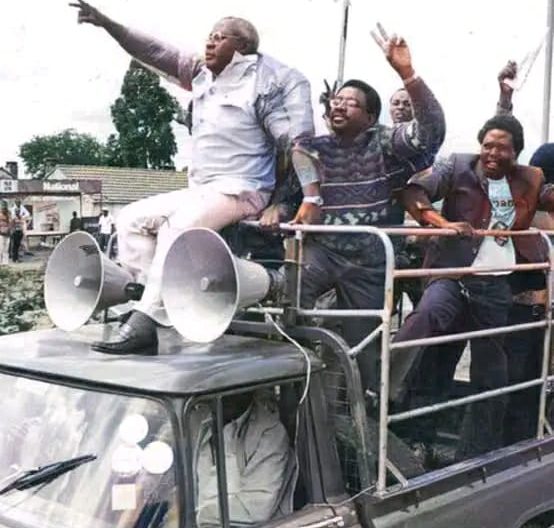
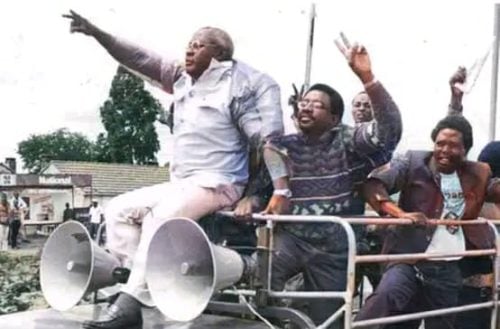
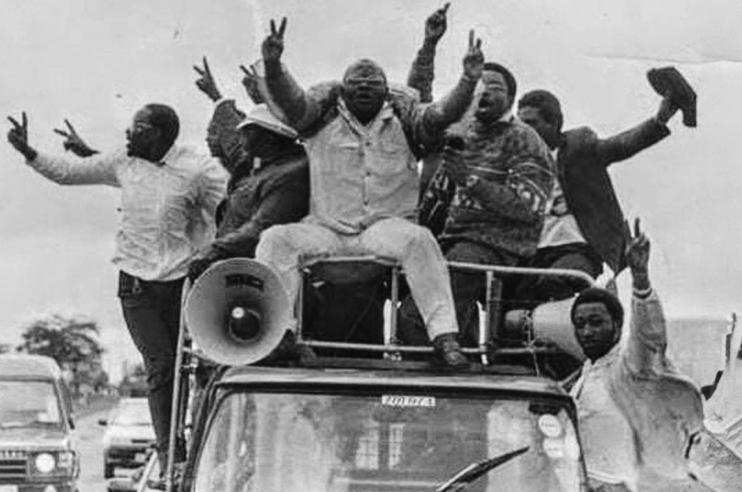
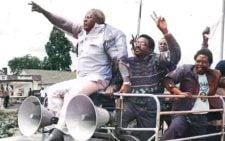
Photographs from that period show Orengo alongside Martin Shikuku, defiantly flashing the victory sign as they mobilised support despite the government ban.
Despite heavy police deployment, thousands of Kenyans turned up on July 7.
Police dispersed demonstrators using tear gas, batons, and live ammunition. Around 20 people were killed, hundreds were injured and over 1,000 protesters were arrested in Nairobi and other towns.
Among those targeted was fellow lawyer Gitobu Imanyara, who was arrested before the planned Kamukunji rally while helping coordinate the pro-democracy movement with Paul Muite and other activists. He was taken to underground detention cells beneath the Nairobi Traffic Police Headquarters on Ngong Road, where he said detainees were held in waterlogged conditions.
“I didn’t know there were underground cells there,” Imanyara recalled in a 2025 interview. “That’s when I discovered, because I was put in one.”
He said police later bundled him into a blue Kombi, where officers kicked and beat him as they drove around Nairobi before taking him underground.
“I could hear screams. I wasn’t the first one there,” he said.
After several days, he was served with a detention order before being transferred to Naivasha and later charged with sedition. His condition deteriorated after torture, and he eventually regained consciousness at Kenyatta National Hospital, where he remained chained to a hospital bed for three and a half months.
Reflecting on that period, Imanyara said many others suffered even worse.
“Many Kenyans went through worse and never lived to tell the story.”
Although the protests were violently suppressed, they marked a turning point in Kenya’s political history.
Growing domestic and international pressure forced Moi’s government to repeal Section 2A in 1991, restoring multiparty politics.
The reforms that followed eventually culminated in the 2010 Constitution, widely regarded as the biggest achievement of the Second Liberation movement.
Why Orengo says the struggle is not over
While many of Saba Saba’s objectives were achieved, Orengo argues that Kenya has failed to fully protect the gains won through years of sacrifice.
Ahead of the 2025 Saba Saba anniversary, he wrote on X:
“The dream of Saba Saba was enshrined in Katiba 2010. Before the ink dried, it was turned on its head, and every pillar of it weakened. Everything has not been spared, including the separation of church and state. So the struggle must continue: Mwakenya, Saba Saba, Gen Z, and on and on.”
His message linked the original democracy movement with today’s youth-led campaigns demanding accountability and constitutional governance.
Orengo backs the 2026 Saba Saba movement
Speaking in Nairobi on July 7, 2026, Orengo again defended the annual Saba Saba commemorations, saying many of the grievances that inspired the 1990 protests still exist.
“They are unhappy because the foundational principles upon which this struggle started have not been met,” he said.
Although Kenya now has constitutional protections and competitive elections, Orengo argued that many rights remain under threat.
He cited abductions, enforced disappearances, extrajudicial killings and prosecutions on what he described as trumped-up charges.
Turning to the economy, he said ordinary Kenyans continue to struggle with the rising cost of living and heavy taxation.
“If you ask an ordinary civil servant whether life is better compared to three or four years ago, they will tell you it is not,” he said.
He also referred to the Gen Z protests that erupted over taxation and governance, arguing that many of the concerns raised by young people remain unresolved.
“If you go through each one of them, including taxation, nothing has really changed. That’s why people are very unhappy.”
A bridge between two generations
Unlike the original Saba Saba movement, which was led largely by opposition politicians and lawyers, the 2026 demonstrations have been organised mainly by young activists and grassroots civic groups.
Yet Orengo sees continuity rather than difference.
For him, the demands have evolved from ending one-party rule to ensuring the Constitution is fully implemented, protecting human rights, strengthening institutions and holding leaders accountable.
His political journey mirrors Kenya’s democratic evolution.
From imprisonment and exile in the 1980s, to standing alongside the architects of Saba Saba in 1990, and now serving as a governor supporting constitutional rights in 2026, Orengo remains one of the few leaders whose career spans every major chapter of Kenya’s struggle for democracy.
As Kenya marks another Saba Saba anniversary, Orengo maintains that democracy is not secured by a single protest or constitutional change.
Instead, he says, it depends on each generation continuing the fight to defend the freedoms won by those who came before them.
Author
Kenneth Mwenda
Kenneth Mwenda is a business, sports, and politics digital writer with over seven years of experience in journalism, covering breaking news, feature stories, and in-depth analysis across a range of beats.
For inquiries, he can be reached at [email protected]
View all posts by Kenneth MwendaLatest News

Advertisement
More on Insights