Advertisement
US Congress introduces green card bill for Haitians after Supreme Court deportation ruling
Tuesday 07th July, 2026 10:37 PM|

As hundreds of thousands of Haitians in the United States brace for the possible loss of Temporary Protected Status (TPS), a new bill introduced in Congress seeks to dramatically alter their future by offering eligible immigrants a pathway to permanent residency instead of deportation.
The Haitian Refugee Immigration Fairness Act of 2026 comes at a pivotal moment for U.S. immigration policy. Its introduction follows a U.S. Supreme Court decision allowing the Trump administration to move forward with ending TPS protections for approximately 330,000 Haitians, placing many at risk of removal despite an escalating humanitarian crisis in their homeland.
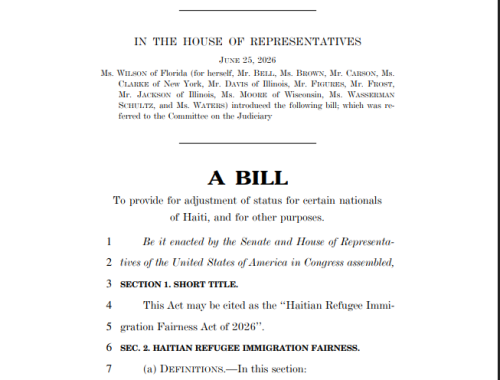
“The purpose of the bill is to provide for adjustment of status for certain nationals of Haiti, and for other purposes,” the legislation introduced in the House of Representatives on June 25, 2026, by Florida Congresswoman Frederica Wilson and a coalition of Democratic lawmakers, read in part.
If enacted, the bill would require the Secretary of Homeland Security to grant eligible Haitian nationals lawful permanent residence.
You Might Also Like



“The Secretary shall adjust the status of qualifying applicants to that of an alien lawfully admitted for permanent residence, provided they apply within three years of the law’s enactment and meet the eligibility requirements,” the bill reads.
The proposal directly contrasts with the current immigration trajectory. Following the Supreme Court’s ruling, work authorisations for affected Haitian TPS holders are expected to expire, exposing thousands to deportation unless they qualify under another immigration category.
The decision has sparked concern among immigrant advocates, healthcare providers and employers, who warn that the removal of Haitian workers could deepen labour shortages, particularly in the caregiving sector where more than 13,000 Haitian TPS beneficiaries are employed as nursing assistants.
Against that backdrop, the proposed legislation seeks to create a permanent legal solution. It would apply to Haitian nationals who have been continuously present in the United States since June 26, 2024, as well as qualifying spouses, children and unmarried sons or daughters.
“An eligible applicant is a Haitian national who has been continuously present in the United States during the period beginning on June 26, 2024, through the date the application is submitted,” the bill states.
One of the bill’s most significant provisions addresses deportation proceedings. It states that Haitians already facing exclusion, deportation or removal orders would still be permitted to seek permanent residence without first filing a separate motion to reopen their immigration cases.
The legislation says such individuals may submit an application for adjustment of status if they are otherwise eligible and, if their applications are approved, the government shall cancel any order of removal.
The legislation further provides safeguards while applications are under review. It stipulates that immigration authorities may not order an alien to be removed from the United States while an eligible adjustment application is pending, unless that application is ultimately denied. It also authorises employment during the review process.

Pathway to residency
“Secretary shall authorise employment if an application remains pending for more than 180 days without a final decision,” the legislation reads.
The congressional proposal arrives as conditions inside Haiti continue to deteriorate. Armed gangs now control roughly 70 per cent of the capital, Port-au-Prince, forcing hospitals to shut down, displacing thousands of residents and fuelling one of the Caribbean’s worst humanitarian emergencies.
The US continues to maintain a Level 4 Do Not Travel advisory for Haiti because of widespread gang violence, kidnappings and civil unrest, raising questions among human rights advocates about returning migrants to a country facing profound instability.
Supporters of the legislation argue that the bill acknowledges those realities while recognising the contributions many Haitians have made to the U.S. economy. Beyond healthcare, Haitian TPS beneficiaries work across hospitality, construction, transportation and other industries already struggling with labour shortages.
The bill also states that becoming eligible for permanent residence under the proposed law would not prevent applicants from pursuing other immigration pathways available under U.S. law.
It further specifies that granting lawful permanent residence to eligible Haitians would not reduce the number of immigrant visas available to applicants from other countries.
Author
Latest News







Advertisement
More on News