Advertisement
National Assembly approves CBK Bill to strengthen financial stability
Thursday 25th June, 2026 10:31 PM|

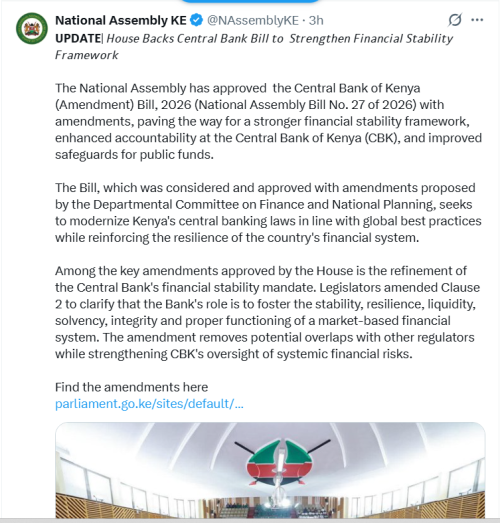
The National Assembly has approved the Central Bank of Kenya (Amendment) Bill, 2026, paving the way for reforms aimed at strengthening financial stability, enhancing accountability at the Central Bank of Kenya (CBK), and improving safeguards for public funds.
The Bill, which was passed with amendments proposed by the Departmental Committee on Finance and National Planning, seeks to modernise Kenya’s central banking laws in line with global best practices while reinforcing the resilience of the country’s financial system.
Lawmakers approved the legislation during the Committee of the Whole House stage, with several amendments designed to clarify the CBK’s mandate and strengthen its oversight role within the financial sector.
“The National Assembly has approved the Central Bank of Kenya (Amendment) Bill, 2026 (National Assembly Bill No. 27 of 2026) with amendments, paving the way for a stronger financial stability framework, enhanced accountability at the Central Bank of Kenya (CBK), and improved safeguards for public funds,” National Assembly statement dated June 25, 2026, read in part.
Amendments clarify CBK’s financial stability role
You Might Also Like

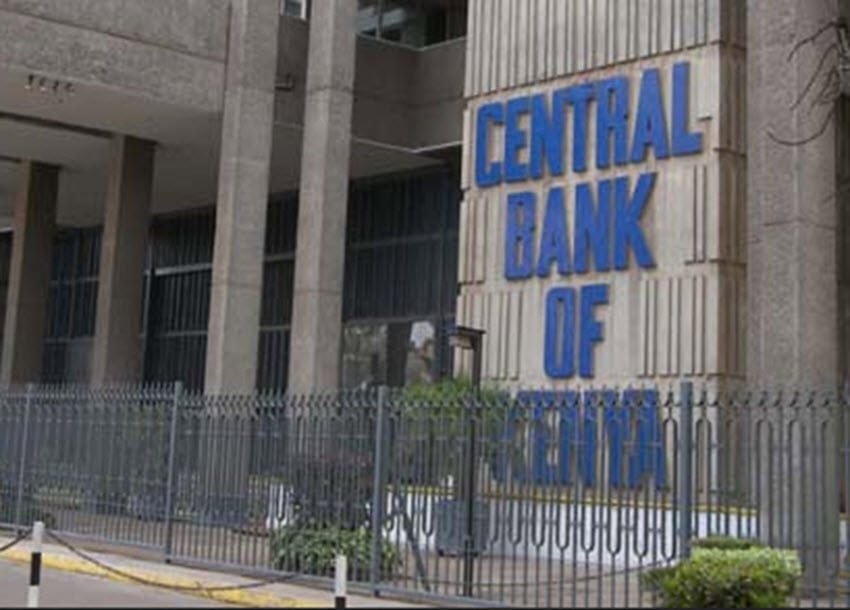

One of the key changes adopted by the House is the amendment of Clause 2, which refines the Central Bank’s financial stability mandate.
The revised provision states that the Bank’s role is to foster “the stability, resilience, liquidity, solvency, integrity and proper functioning of a market-based financial system.”
According to the National Assembly, the amendment is intended to remove potential overlaps between the CBK and other financial sector regulators while strengthening the Bank’s oversight of systemic financial risks.
The House also approved provisions expanding the CBK’s emergency liquidity support framework, allowing the Bank to provide assistance to banks and microfinance institutions facing financial distress under specified conditions.
Further amendments introduce transitional provisions recognising loans and advances granted before the commencement of the new law as compliant under the revised framework.
Changes were also made to provisions relating to gold and precious metals reserves, with the amendments aimed at modernising reserve management practices and aligning them with evolving financial sector needs.
Focus on accountability and public funds
The Bill also introduces governance reforms intended to strengthen accountability within the Central Bank.
Among the changes approved by MPs is the concentration of the vetting process for deputy governors in the National Assembly, a move expected to enhance parliamentary oversight of senior CBK appointments.
The reforms are designed to improve transparency, strengthen institutional checks and balances, and safeguard public resources.
The legislation was considered alongside other financial sector measures before the House, including the Kenya Revenue Authority (Amendment) Bill and the County Allocation of Revenue Bill.
Bill moves to next legislative stage
The approval marks another step in ongoing efforts to strengthen Kenya’s financial architecture amid changing economic conditions and emerging risks within the banking sector.
The amendments seek to provide the CBK with clearer powers to address financial stability concerns while ensuring coordination with other regulators operating within the financial system.
Once the legislative process is completed, the reforms are expected to support a more resilient financial sector by enhancing the Bank’s capacity to respond to liquidity challenges and oversee systemic risks.
The Bill now proceeds to the next stage of the legislative process before it can become law. Parliament said the amendments are aimed at ensuring the country’s central banking framework remains responsive to current and future financial sector developments.
Author
Latest News







Advertisement
More on Business