Advertisement
Inside govt strategy to cushion Kenyans from high fuel costs over import shocks
Saturday 16th May, 2026 05:56 PM|

Fuel prices have once again returned to the centre of national debate after another sharp increase pushed transport and living costs higher across the country. Super petrol in Nairobi now retails at Ksh214.25 per litre, while diesel has climbed to Ksh242.92.
The latest adjustment, announced by the Energy and Petroleum Regulatory Authority (EPRA), has added pressure on households already struggling with high food and transport costs. The rise stems largely from a sharp jump in landing costs – the price of imported fuel when it arrives at the port before taxes and margins.
EPRA data shows the average landed cost of super petrol rose 10 per cent from $823.27 (Ksh106,407.65) per cubic metre in March to $906.23 (Ksh117,130.23) in April, while diesel recorded an even steeper 20.32 per cent increase from $1,073.82 (Ksh138,791.23) to $1,291.98 (Ksh166,988.42) per cubic metre.
The rise has triggered fresh political and policy responses. Kiharu MP Ndindi Nyoro has written to National Assembly Speaker Moses Wetang’ula calling for an urgent recall of Parliament from recess. He wants lawmakers to debate tax changes aimed at cutting fuel prices, including a reduction of VAT on fuel to zero, a cut in the Road Maintenance Levy Fund, and expanded use of subsidies.
You Might Also Like

“Following our proposal to amend various laws with the aim of reducing fuel prices, we have written to the Speaker of the National Assembly with a request to recall the House from recess at the earliest, preferably Monday,” Nyoro said.
His proposals, he argues, could reduce petrol and diesel prices by more than Ksh15 per litre and ease inflationary pressure across the economy. But even as Parliament considers short-term fixes, energy officials are again pointing to a longer-term solution: local production and refining of oil.

Govt plan on dealing with import shocks
Principal Secretary for Energy Alex Wachira has revived the argument for regional energy independence, saying East Africa must build its own refining capacity to reduce exposure to global shocks.
“It is very important for us people of East Africa to have our own refineries, because when we get supply shocks like we are currently having, then if we have a refinery within our own area of Eastern Africa, then we are kind of cushioned from the supply shocks,” Wachira stated on Saturday, May 16, 2026.
His comments reflect a broader shift in energy thinking across the region. Kenya, like most African economies, imports nearly all its refined petroleum products, leaving it exposed to global crude price swings, currency fluctuations, and supply chain disruptions. EPRA has repeatedly pointed to these external pressures, alongside taxes, as the main drivers of retail price increases.
Wachira also raised concerns about the inefficiencies of relying on imports and exporting crude without adding value locally.
“Right now, fuel prices are high. But they have not risen because of any individual. No, they have gone high because of the war in the Middle East,” he said. He argued that local refining would ensure crude resources in the region translate into more stable and predictable fuel pricing.
Development in Turkana’s South Lokichar basin now gathers pace. Gulf Energy bought Tullow Oil’s stake for about $120 million (Ksh15.5 billion) in 2025 and took full control of Blocks 10BB and 13T. The field holds around 560 million recoverable barrels.
Kenya Revenue Authority added pressure by demanding Ksh22 billion from Tullow for underpaid VAT and capital gains tax on the exit. Tullow called the claim without merit and plans to contest it with Gulf Energy.
Lokichar hope
In late April 2026, Energy Cabinet Secretary Opiyo Wandayi led a groundbreaking ceremony in Lokichar. Gulf Energy targets first commercial production and exports by December 2026. Early output could reach 20,000 barrels per day and rise later to 50,000. The company plans to invest up to $6 billion (Ksh774 billion).
EPRA launched a petroleum cost recovery audit in April to make sure companies claim only legitimate expenses under production-sharing contracts. The audit checks invoices, budgets and royalty payments so the government receives its full share.
Former Deputy President Rigathi Gachagua raised stronger questions. He claimed that profits from high fuel prices help fund the Turkana acquisition. He offered no evidence, and officials rejected the claim. Still, his remarks show how fuel prices now fuel political debate ahead of the 2027 elections.
Communities in Turkana demand transparency, jobs and local benefits after years of delays. Gulf Energy promises to deliver, but past disputes over costs, waxy crude and infrastructure remind everyone that delivery matters more than announcements.
Officials view Turkana as a potential turning point in reducing reliance on imported refined fuel. However, the project has faced repeated delays over infrastructure gaps, financing constraints, and disputes over commercial viability. Even now, questions remain over how quickly local crude production can meaningfully influence domestic fuel prices.
Dangote refinery talks tilt towards Mombasa
At the same time, attention is shifting to broader regional refinery ambitions. President William Ruto has previously backed plans for a joint East African refinery, initially linked to Tanzania’s Tanga port. More recently, momentum has shifted towards Mombasa, which offers deeper port facilities and a larger domestic fuel market.
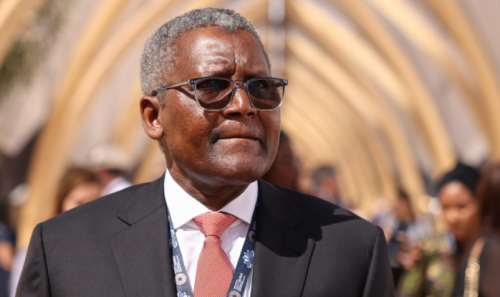
That shift has been reinforced by interest from Nigerian industrialist Aliko Dangote, who is exploring a large-scale refinery project in East Africa. The project could cost between $15 billion and $17 billion (Ksh1.94 trillion and Ksh2.19 trillion) and process 650,000 barrels per day.
Dangote has openly signalled a preference for Kenya as a potential location.
“I’m leaning more towards Mombasa because Mombasa has a much larger, deeper port. Kenyans consume more. It’s a bigger economy,” he told the Financial Times.
If realised, the project would mark one of the most significant shifts in East Africa’s energy architecture in decades. The region currently lacks a functioning large-scale refinery following the collapse of the Mombasa refinery in 2013. Uganda is developing a smaller facility in Hoima, but it is not designed to meet regional demand on its own.
The broader backdrop is continued instability in global energy markets. Supply disruptions in the Middle East and volatility in shipping routes have repeatedly exposed the risks faced by import-dependent economies. For Kenya, these shocks translate almost immediately into higher pump prices.
This is why policy experts argue that tax cuts and subsidies, while politically necessary in the short term, do not address the structural vulnerability. EPRA maintains that fuel prices reflect international crude benchmarks, exchange rates, and domestic tax obligations, leaving limited room for long-term insulation without structural change.
The government has attempted to soften the impact through targeted interventions, including a Ksh5 billion allocation from the Petroleum Development Levy Fund aimed mainly at diesel and kerosene consumers. But the relief has been temporary and quickly absorbed by global market movements.
A similar pattern was seen in April, when Parliament reduced VAT on fuel from 16 per cent to 8 per cent. The move delivered short-lived price relief before global oil prices and currency pressures reversed the gains.
This cycle has strengthened calls for a shift away from reactive policy tools towards structural reforms. Supporters of local refining argue that processing crude within the region would reduce import dependence, improve energy security, and support industrial growth through job creation and lower logistics costs.
For now, Kenya finds itself balancing two competing approaches. One is immediate political pressure to ease household costs through tax reductions and subsidies. The other is long-term investment in oil production in Turkana and potential regional refining capacity anchored in Mombasa.
Author
Kenneth Mwenda
Kenneth Mwenda is a business, sports, and politics digital writer with over seven years of experience in journalism, covering breaking news, feature stories, and in-depth analysis across a range of beats.
For inquiries, he can be reached at [email protected]
View all posts by Kenneth MwendaLatest News








Advertisement
More on Business