Advertisement
How tax shortfalls widened KRA’s revenue gap in 2025/26
Monday 01st June, 2026 06:28 PM|

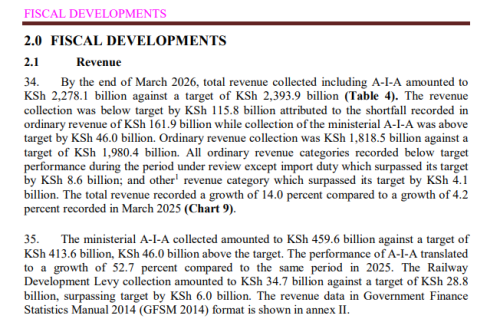
The latest government data shows that the Kenya Revenue Authority (KRA) collected less tax than planned in the first nine months of the 2025/26 financial year. The figures appear in the National Treasury’s Quarterly Economic and Budgetary Review for the period ending 31 March 2026.
The report does not cover a shortfall of KSh 163 billion for July to December 2024. Instead, it focuses on the July 2025 to March 2026 period and shows a slightly different gap of Ksh161.9 billion in ordinary revenue.
According to the report, ordinary revenue reached Ksh1,818.5 billion against a target of Ksh1,980.4 billion. This left a deficit of Ksh161.9 billion.
When ministerial Appropriation-in-Aid (A-I-A) is included, total revenue collection rose to Ksh2,278.1 billion against a target of Ksh2,393.9 billion. The overall gap narrowed to Ksh115.8 billion.
You Might Also Like



The Treasury explained the shortfall clearly in its report. It stated:
“The revenue collection was below target by Ksh115.8 billion attributed to the shortfall recorded in ordinary revenue of Ksh161.9 billion while collection of the ministerial A-I-A was above target by Ksh46.0 billion.”
The data shows that KRA performed below expectations across most tax categories. Corporation tax recorded the largest deficit, followed by Pay As You Earn (PAYE), which both failed to meet their targets by wide margins.
The report noted: “Among the major tax headings, corporation tax recorded the largest deficit followed by PAYE.”
Other tax heads also underperformed. Excise duty, VAT, and investment income all fell short of targets. VAT alone missed its target by Ksh 42.8 billion.
Only a few categories performed above target. Import duty exceeded expectations by Ksh8.6 billion, while other minor revenue streams added Ksh4.1 billion.
Despite the shortfall, revenue still grew compared to the previous year. Ordinary revenue stood at Ksh1.58 trillion during the same period in 2024/25, showing that collections increased by 14 percent year on year. However, this growth was not enough to meet the revised targets.
The gap widened over time. By December 2025, the shortfall stood at Ksh110.6 billion. By March 2026, it had increased to Ksh161.9 billion, showing continued pressure on tax collection.
Tax cuts and borrowing
The report links the performance partly to policy decisions that reduced tax intake. These included tax relief measures aimed at easing pressure on households and businesses. One of the major changes was a reduction in VAT on fuel products to cushion consumers from rising global energy costs.
The government also signalled further tax changes. President William Ruto announced plans to exempt Kenyans earning below Ksh30,000 from PAYE tax, a move expected to reduce the tax base further.
Despite weaker revenue collection, the economy continued to expand. Real GDP grew by 4.6 percent in 2025, supported by construction, mining and services. Inflation remained stable at 4.4 percent in March 2026, while the shilling held steady against the US dollar.
Foreign exchange reserves also strengthened, reaching 5.7 months of import cover, giving the economy a buffer against external shocks.
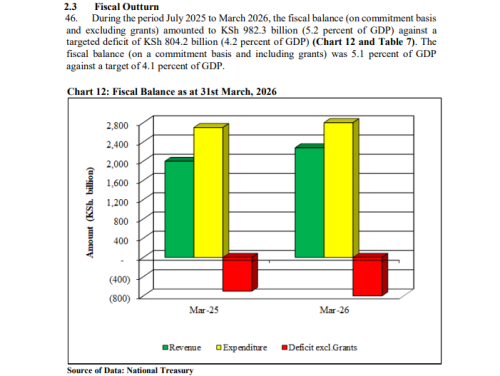
However, weak revenue performance forced the government to rely more on borrowing. Net domestic borrowing reached Ksh700.7 billion during the period under review. This helped cover the fiscal gap created by lower-than-expected tax collection.
The report shows that the fiscal deficit widened to Ksh982.3 billion, or 5.2 percent of GDP, higher than the planned level of 4.2 percent. This reflects the pressure that missed revenue targets placed on public finances.
The Treasury said the figures highlight both progress and strain in the tax system. While collections improved compared to last year, they still fell short of government expectations.
For Kenya Revenue Authority, the challenge now is to close the gap in the final quarter of the financial year. The authority will need stronger compliance efforts and wider tax coverage if it is to meet its full-year target.
The National Treasury said the outlook depends on economic activity and policy decisions. It expects improved performance if growth continues and if tax administration improves, but the current figures show that meeting targets will remain difficult without stronger collections in key tax areas such as corporation tax and PAYE.
Author
Kenneth Mwenda
Kenneth Mwenda is a business, sports, and politics digital writer with over seven years of experience in journalism, covering breaking news, feature stories, and in-depth analysis across a range of beats.
For inquiries, he can be reached at [email protected]
View all posts by Kenneth MwendaLatest News





Advertisement
More on Business