Advertisement
Breakdown of how fuel will retail across major towns after EPRA review
Wednesday 15th April, 2026 10:46 AM|
The Energy and Petroleum Regulatory Authority (EPRA) has announced new fuel price adjustments for the April–May pricing cycle, outlining a fresh surge in pump prices across the country driven by higher global oil costs and increased landed import expenses.
In its latest review, EPRA stated that the maximum retail prices will apply from April 15, 2026, to May 14, 2026, reflecting significant upward revisions. Super petrol has risen by Ksh28.69 per litre, while diesel has increased by Ksh40.30 per litre.
“We have calculated the maximum retail prices of petroleum products which will be in force from April 15, 2026, to May 14, 2026,” EPRA said in a statement.
Kerosene, however, has remained unchanged, offering slight relief for households relying on it for cooking and lighting.
You Might Also Like



“The prices are inclusive of the Value Added Tax (VAT) in line with the VAT Act, the Finance Act 2023, the Tax Laws (Amendment) Act 2024 and the revised excise duty rates adjusted for inflation,” EPRA said.
Despite government cushioning measures such as reduced VAT on petroleum products and support from the Petroleum Development Levy, global market pressures have continued to push local prices upward.
EPRA linked the adjustment to a sharp rise in landed costs, with imported fuel prices climbing steeply over the past month.
Region’s major towns price distributions
Across major towns, EPRA’s list shows motorists will now face higher costs at the pump, with regional variations reflecting transport and distribution expenses.
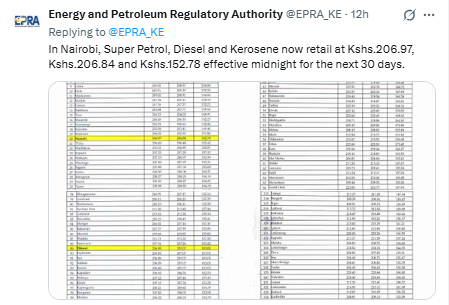
In Nairobi, super petrol will retail at Ksh206.97, diesel at Ksh206.84 and kerosene at Ksh152.78 per litre. Mombasa remains slightly cheaper due to its port advantage, with petrol at Ksh 203.69, diesel at Ksh203.56 and kerosene at Ksh149.49.
Western Kenya continues to record some of the highest prices. In Kisumu, petrol will cost Ksh209.00, diesel Ksh208.87 and kerosene Ksh154.81. Nakuru and Eldoret will also see elevated rates, with both towns recording around Ksh209 for petrol, about Ksh208 for diesel and roughly Ksh154–155 for kerosene.

In central Kenya, Nyeri will sell petrol at Ksh208.98, diesel at Ksh208.85 and kerosene at Ksh154.78, while Embu will have slightly lower rates of Ksh208.50 for petrol, Ksh208.38 for diesel and Ksh154.31 for kerosene. Meru and surrounding towns will cross the Ksh209 mark for petrol and Ksh208 for diesel, with kerosene edging above Ksh155.

Eastern Kenya
Eastern Kenya has recorded some of the steepest increases. Kitui will see petrol at Ksh209.24, diesel at Ksh209.12 and kerosene at Ksh155.05, while Mwingi will experience even higher prices of Ksh209.92 for petrol, Ksh209.79 for diesel and Ksh155.72 for kerosene.
In the coastal and remote regions, transport costs continue to influence pricing. Lamu will have petrol at Ksh209.02, diesel at Ksh208.91 and kerosene at Ksh154.84, while Hola records Ksh209.51 for petrol, Ksh209.39 for diesel and Ksh155.33 for kerosene. In Taveta, prices remain slightly lower at Ksh208.30 for petrol, Ksh208.19 for diesel and Ksh154.12 for kerosene.
EPRA attributed the widespread increase to a sharp rise in global oil benchmarks, noting that the average landed cost of super petrol rose by over 41 per cent, diesel by nearly 69 per cent, and kerosene by more than 105 per cent between February and March, 2026.
With most towns now seeing petrol prices crossing the Ksh200 mark, the regulator warned that the latest review could add further pressure to the cost of living, despite ongoing government interventions aimed at stabilising fuel prices.
Author
Latest News








Advertisement
More on Business