Advertisement
Willis Otieno blasts Atwoli over National Infrastructure Fund remarks
Tuesday 16th December, 2025 05:07 PM|

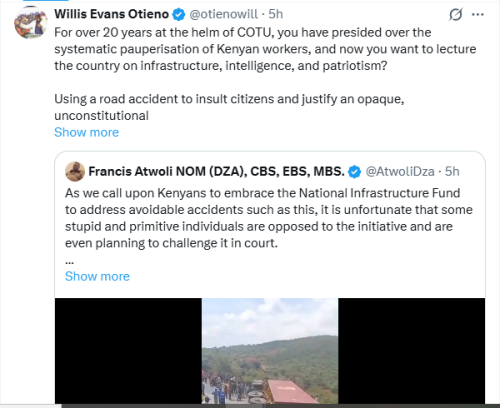
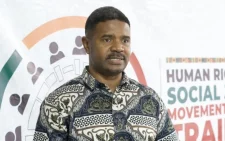
City lawyer Willis Otieno has called out the Central Organisation of Trade Unions (COTU) Secretary General Francis Atwoli following his remarks linking the proposed National Infrastructure Fund to the prevention of road accidents and accelerated development.
Francis Atwoli took to X on Tuesday, December 16, 2025, commenting on a road accident that had, according to him, disconnected Nairobi from the rest of Western Kenya. He added that the newly established National Infrastructure fund would have prevented the carnage if it were in place.
”As we call upon Kenyans to embrace the National Infrastructure Fund to address avoidable accidents such as this, it is unfortunate that some stupid and primitive individuals are opposed to the initiative and are even planning to challenge it in court. Kenya urgently needs the National Infrastructure Fund to prevent such avoidable tragedies because, as we speak, Nairobi has been cut off from several parts of western Kenya due to an accident of this nature that could have been prevented with proper infrastructure investment,” Atwoli said.
In response to the remarks, Otieno accused Atwoli of exploiting a national tragedy to push what he described as an opaque and unconstitutional fund, arguing that the labour leader’s comments amounted to emotional manipulation rather than a sober policy debate.
You Might Also Like

“For over 20 years at the helm of COTU, you have presided over the systematic pauperisation of Kenyan workers, and now you want to lecture the country on infrastructure, intelligence, and patriotism?” Otieno posed, questioning Atwoli’s moral authority to champion the fund.
At the centre of Otieno’s criticism is Atwoli’s suggestion that the lack of a dedicated infrastructure fund is to blame for deadly road accidents. Otieno dismissed this argument as misleading, insisting that Kenya’s infrastructure problems are not rooted in funding shortages but in corruption, incompetence and theft of public resources.
“Using a road accident to insult citizens and justify an opaque, unconstitutional fund is emotional blackmail,” Otieno said, adding that Kenya has borrowed, taxed and collected enough revenue over the years to construct world-class roads. According to him, the persistent failures on Kenyan roads point to mismanagement of existing resources rather than the absence of new ones.
Otieno further took issue with Atwoli’s alleged dismissal of critics of the fund as “stupid and primitive,” saying such language exposes the deep disconnect between union leadership and the realities facing ordinary workers. He argued that demands for parliamentary oversight, transparency and constitutional compliance are legitimate and should not be met with insults.
“Calling people names for demanding accountability only confirms why workers are in trouble,” Otieno said, accusing Atwoli of confusing longevity in office with tangible achievement.

In a sharp assessment of Atwoli’s long tenure at COTU, Otieno painted a grim picture of the state of Kenyan workers. He noted that after more than two decades under the same leadership, workers are poorer, trade unions are weaker, casualisation has become widespread, and wages have failed to keep pace with inflation.
Otieno warned that presenting the National Infrastructure Fund as a cure-all for Kenya’s problems risks entrenching the very governance failures that have plagued public projects for decades.
“Now, conveniently, the solution is ‘Give us Ksh5 trillion first. Ask questions later,’” he said, cautioning that such an approach undermines constitutional safeguards and public trust.
The remarks add to growing public debate over the proposed National Infrastructure Fund, with critics questioning its legality, governance structure and potential to open new avenues for misuse of public funds.
Author
Latest News






Advertisement
More on News
