Advertisement
WHO: 2.4B workers exposed to extreme heat
Friday 22nd August, 2025 07:27 PM|

A new joint report by the World Health Organization (WHO) and the World Meteorological Organization (WMO) has raised alarm over the growing threat of extreme heat on the global workforce amid climate action.
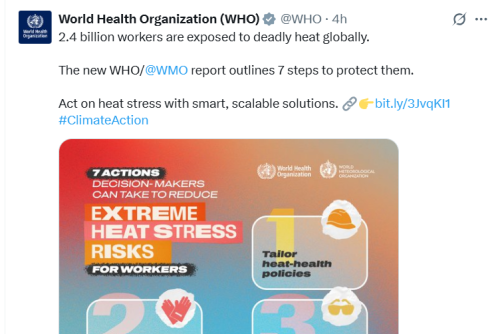
WHO on an X post dated August 22, 2025, revealed that 2.4 billion workers—around 70 per cent of the world’s workforce—are now exposed to dangerous heat conditions, posing serious risks to health, productivity, and livelihoods.
The warning comes after 2024 was recorded as the hottest year on record, with some regions experiencing daytime temperatures soaring past 50°C.
The report notes that heat stress is already undermining both economic security and public health, particularly in developing nations where vulnerable groups such as children, older adults and low-income workers bear the greatest burden.
You Might Also Like
WHO’s Assistant Director-General for Health Promotion, Disease Prevention and Care, Jeremy Farrar, said billions of workers in sectors such as agriculture, construction and fisheries are facing severe challenges. “This new guidance offers practical, evidence-based solutions to protect lives, reduce inequality, and build more resilient workforces in a warming world,” he noted.
Rising risks and productivity losses
The findings highlight a sharp increase in both the frequency and intensity of heatwaves worldwide. Health risks such as heatstroke, dehydration, kidney dysfunction and neurological disorders are now widespread among workers. Productivity is also heavily affected, with estimates showing a 2 to 3 per cent drop in output for every degree above 20°C.
WMO Deputy Secretary-General Ko Barrett said occupational heat stress has become not just a health issue but a serious economic challenge. “Protection of workers from extreme heat is not just a health imperative but an economic necessity,” he stated.
The International Labour Organization (ILO) supported the report, revealing that excessive heat contributes to more than 22.8 million workplace injuries annually. ILO’s Chief of Occupational Safety and Health, Joaquim Pintado Nunes, called for urgent global action, stressing that worker safety and dignity must remain central to climate adaptation efforts.
Africa calls for urgent action
The urgency of the crisis was echoed in Africa, where 17 of the world’s 20 most climate-vulnerable countries are located.
Legislators meeting at the 54th Commonwealth Parliamentary Association Africa Region Conference in Banjul, Gambia, on August 15, 2025, stressed the need to align climate action with economic integration under the African Continental Free Trade Area (AfCFTA).
The session, chaired by Kenya’s Deputy Speaker Gladys Shollei, resolved that parliaments must not only sign climate commitments but also implement them through laws and budgetary support.
In Kenya, Environment Cabinet Secretary Deborah Mlongo Barasa has called for accelerated funding under the Financing Locally-Led Climate Action (FLLoCA) programme to strengthen resilience and generate green jobs. The ministry reports that FLLoCA has already created 57,000 jobs tied to local climate interventions.
The report ultimately calls for coordinated plans by governments, employers, unions and health experts to safeguard workers as climate impacts intensify. With nearly half the global population already feeling the effects of excessive heat, WHO and WMO warn that urgent investments are needed to protect both lives and economies.
Author
Latest News





Advertisement
More on News