Advertisement
Safina Party SG cites resilience in 2025, renews push for economic change
Friday 26th December, 2025 02:53 PM|

As Kenyans mark the Christmas season, the Safina Party has reflected on the challenges of 2025 while expressing renewed determination to pursue economic transformation in the coming year.
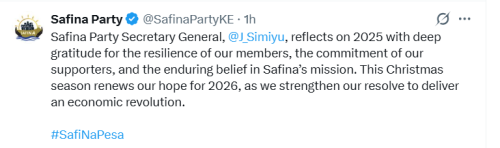
In a message shared on X on December 26, 2025, Safina Party Secretary General Joakim Simiyu expressed gratitude for the resilience shown by party members and supporters during the year.
The message noted that the festive season offers an opportunity for reflection and hope, while reaffirming the party’s commitment to advancing an economic revolution in 2026.
The statement framed the past year as one defined by perseverance amid economic and political pressures, while positioning the party for renewed momentum in the year ahead. It also linked the party’s outlook to its broader objective of pursuing people-centered economic reforms, as Safina prepares to intensify its activities going into 2026.
You Might Also Like



“Safina Party Secretary General, @J_Simiyu, reflects on 2025 with deep gratitude for the resilience of our members, the commitment of our supporters, and the enduring belief in Safina’s mission. This Christmas season renews our hope for 2026, as we strengthen our resolve to deliver an economic revolution,” read the X post.
Leadership transition
The end-of-year message comes amid renewed activity within Safina Party following a major leadership transition earlier in 2025. Founded in 1995 to combat tribalism and promote equality, the party underwent a generational shift during its National Delegates Conference held on September 18, 2025, at Ngong Racecourse in Nairobi.
During the conference, outgoing party leader Paul Muite formally handed over leadership to businessman and 2027 presidential hopeful Jimi Wanjigi.
Muite passed on key symbols of leadership, including the party constitution and registry, in a transition that emphasised continuity while calling for decisive action on national challenges.
The conference drew participation from diverse groups, including youth, reflecting the party’s intention to broaden its appeal ahead of future elections.
Deputy Party Leader Willis Otieno described the transition as a pivotal moment for Safina, positioning the party to address governance challenges such as debt, taxation and public resource allocation. The leadership change marked a new phase in the party’s efforts to reposition itself within Kenya’s political landscape.
Economic agenda and policy focus
Under the new leadership, Safina has centered its agenda on what it describes as an “Economic Revolution.” In his inaugural address, Wanjigi introduced the FIST Agenda, which prioritises universal health coverage, free education, repudiation of odious debts and reforms within the security sector.
The framework aims to reduce taxation pressure, improve access to credit and restore economic dignity for citizens.
Otieno has further outlined proposals for security reforms, including elected Officers Commanding Police Divisions and the establishment of People’s Boards at police stations to enhance accountability. Since the leadership transition, the party has sustained engagement through women’s forums and policy discussions on taxation, domestic borrowing and social services.
Author
Latest News







Advertisement
More on News