Advertisement
Police top Kenya’s bribery index amid calls for reform
Thursday 31st July, 2025 03:41 PM|

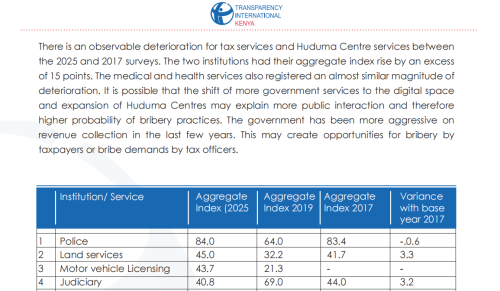
The Kenya Bribery Index 2025 by Transparency International Kenya (TI-Kenya) has ranked the police as the most bribery-prone institution in the country, scoring a high 84.0 on the aggregate bribery index.
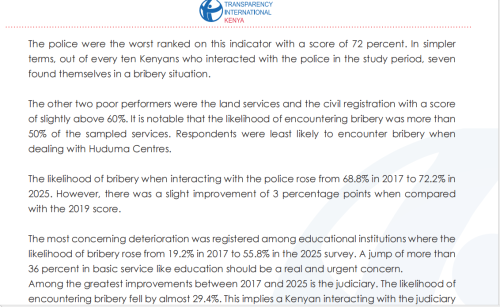
The findings, drawn from a nationwide survey conducted between February and March 2025 across 15 counties, paint a troubling picture of persistent corruption in public service delivery, with the police leading in both the likelihood (72%) and prevalence (51%) of bribe demands.
“The police was the worst ranked on this indicator with a score of 72 percent. In simpler terms, out of every ten Kenyans who interacted with the police in the study period, seven found themselves in a bribery situation,” read part of the TI-Kenya report dated July 31, 2025.
According to the survey, 25% of respondents encountered a bribery situation when interacting with public institutions, and of those, 68% admitted to paying. The police alone accounted for nearly 40% of all bribes reported, raising fresh concerns over accountability and the effectiveness of existing oversight mechanisms. “The consistent ranking of the police as the most bribery-prone institution is an indicator of deep-seated structural weaknesses,” TI-Kenya said, urging the National Police Service to revisit and implement recommendations from previous reform reports.
You Might Also Like



Among the key proposals are automation of services, including online crime reporting and digital payment systems for traffic fines, alongside the adoption of body-worn cameras to enhance transparency and deter extortion.
Bribery persists
Other sectors fared poorly in the index as well, with land services scoring 45.0 and motor vehicle licensing at 43.7. The average bribe in land services stood at Ksh 12,610, underlining the costly barriers citizens face while accessing essential services. In contrast, Huduma Centres were noted for their efficiency and lower susceptibility to bribery, with a likelihood rate of just 9%.
TI-Kenya emphasised the urgent need to accelerate digitisation of public services, particularly in land registries through platforms like Ardhi Sasa, to reduce face-to-face interactions that often lead to bribery demands. “The government should fast-track digitisation processes for the provision of public services,” the report states.
The organisation also reiterated the importance of enforcing the Anti-Bribery Act, 2016, which outlines offences related to bribery and mandates entities to implement preventive procedures. Under the Bribery Act Regulations 2021, all entities were required to comply by May 26, 2022, but TI-Kenya notes that enforcement remains weak.
The report also highlighted a slight improvement in reporting behavior, with 17% of respondents admitting to reporting bribery incidents—up from 13% in 2019. However, TI-Kenya says more must be done to encourage reporting.
It recommends that the Ethics and Anti-Corruption Commission (EACC) and the Commission on Administrative Justice establish accessible whistleblower and feedback systems.
TI-Kenya concludes that only through strict enforcement, digital reform, and citizen empowerment can Kenya move closer to achieving a corruption-free society.
Author
Latest News








Advertisement
More on News