Advertisement
Parliament passes privatisation Bill
Thursday 09th October, 2025 06:11 PM|

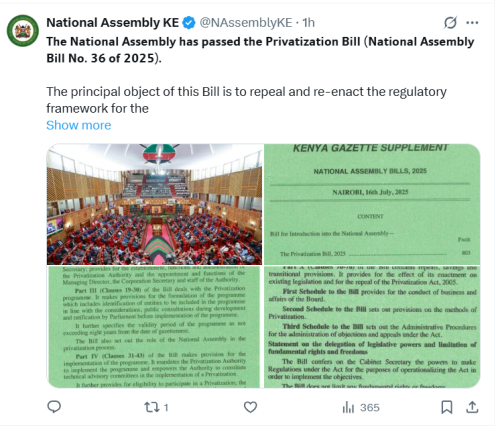
The National Assembly has passed the Privatisation Bill (National Assembly Bill No. 36 of 2025), marking a significant step in reforming Kenya’s regulatory framework for the privatisation of public entities.
According to the National Assembly’s post on X, on October 9, 2025, the primary objective of the Bill is to repeal and replace the existing framework to enhance the efficiency of public entities through privatisation.
The legislation introduces a structured approach to privatisation, aiming to streamline processes, ensure transparency, and align with national economic goals. It is organised into six sections that address various aspects of the privatisation process.
Strengthening oversight and coordination
The initial section provides preliminary provisions such as the Bill’s short title, interpretation of key terms, and the scope of transactions exempt from the Act. It also lays out guiding principles and objectives to anchor the legislative framework.
You Might Also Like



The second section focuses on coordination and oversight. It establishes the Privatization Authority and defines its functions, administrative structure, and leadership roles, including those of the Managing Director, Corporation Secretary, and staff. It also outlines the responsibilities of the Cabinet Secretary in overseeing privatization matters to ensure effective coordination at the national level.
Privatisation programme and implementation
The next section outlines the development of the privatisation programme, including the identification of public entities for privatisation based on set criteria, public consultations, and parliamentary approval before implementation. The programme’s validity is capped at eight years from the date of gazetting to ensure timely execution, with the National Assembly playing a key role in ratification.
The implementation framework assigns the Privatisation Authority the responsibility of executing the programme. It allows for the formation of technical advisory committees to support the process and sets eligibility criteria for participation.
It also outlines methods of privatisation and procedures for developing proposals, which require stakeholder engagement and approval by the Authority’s Board and the Cabinet Secretary. Entities identified for privatisation will be subject to specific restrictions and obligations to ensure compliance.
Agreements and use of proceeds
The final sections of the Bill govern the execution of privatisation agreements, specifying the conditions under which such agreements can be finalised and requiring their publication to promote transparency. Clear guidelines are also set for the management of privatisation proceeds to ensure accountability in the handling of funds generated through the process.
The passage of the Bill lays the groundwork for a modernised and regulated approach to privatisation in Kenya’s public sector.
Author
Latest News








Advertisement
More on News