Advertisement
Parliament and police least trusted public institutions in Kenya – TIFA
Thursday 04th June, 2026 11:06 AM|

A new opinion poll by TIFA Research has painted a grim picture of public confidence in Kenya’s institutions, with Parliament and the National Police Service emerging as the least trusted bodies among those surveyed.
According to a survey published on June 4, 2026, by TIFA Research, public scepticism towards leadership, governance structures and public service institutions is rising, with negative sentiment outpacing positive trust across all major institutions. In a question to the general public, the research sought to know the trust of Kenyans in different institutions
“How much trust do you have in the following institutions? Do you have a lot of trust, some trust, only a little trust, or no trust at all?” the TIFA poll questioned.
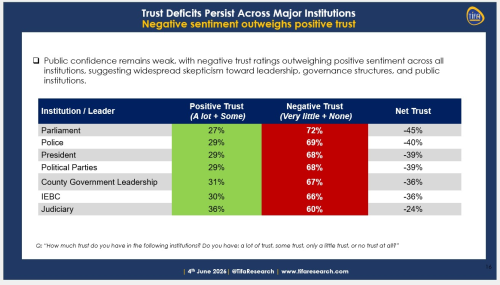
Parliament had the lowest level of public trust, with 72 per cent of respondents reporting little or no trust in the institution. Only 27 per cent expressed positive trust, giving Parliament a net trust rating of -45 per cent, the worst among all institutions surveyed.
You Might Also Like


The National Police Service followed closely with a net trust rating of -40 per cent. According to the poll, 69 per cent of Kenyans reported little or no trust in the police, while only 29 per cent expressed confidence in the institution.
President Ruto ranks third
President William Ruto and political parties were tied with net trust ratings of -39 per cent. Both registered positive trust levels of 29 per cent against negative trust ratings of 68 per cent, suggesting widespread dissatisfaction with the country’s political leadership.
County government leadership and the Independent Electoral and Boundaries Commission (IEBC) each recorded net trust scores of -36 per cent. County governments received a positive trust rating of 31 per cent compared to 67 per cent negative trust, while the IEBC garnered 30 per cent positive trust against 66 per cent negative trust.
Although the judiciary ranked highest among the institutions surveyed, it also had difficulty winning the majority of public confidence. The courts recorded a positive trust rating of 36 per cent and a negative trust rating of 60 per cent, resulting in a net trust score of -24 per cent.
TIFA noted that public confidence remains weak across all institutions assessed, with negative trust ratings consistently surpassing positive sentiment. The results indicate that many Kenyans are still unconvinced about the effectiveness, accountability and responsiveness of the country’s leadership and governance structures.
The survey highlights the challenge that public institutions face in rebuilding trust amid ongoing economic concerns, political tensions and increasing public demands for transparency and accountability.
The results indicate that restoring public trust will remain a critical issue for Kenya’s leaders and institutions as the country navigates key political and economic challenges.
Author
Latest News




Advertisement
More on News