Advertisement
Oburu urges infrastructure push to drive Lake Basin growth and jobs
Saturday 21st March, 2026 09:32 AM|

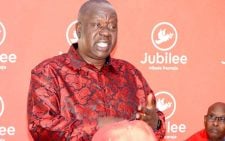
Oburu Oginga, the Siaya Senator and Orange Democratic Movement (ODM) Party leader, has strongly linked infrastructure development to economic growth in the Lake Basin region, emphasising collaborative efforts to drive prosperity and job creation.
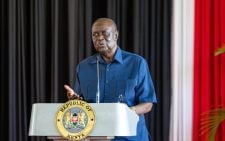
In an X post on March 21, 2026, following Eid-ul-Fitr celebrations in Kisumu, Oburu highlighted his participation in a high-level consultative meeting with President William Ruto and regional leaders. The discussions focused on aligning priorities and fast-tracking key infrastructure initiatives.
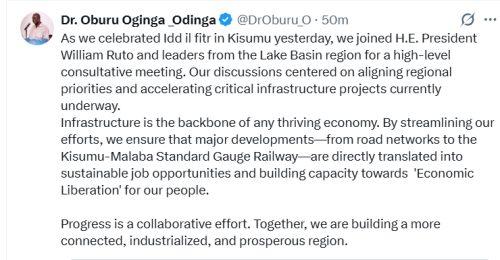
“As we celebrated Idd il fitr in Kisumu yesterday, we joined H.E. President William Ruto and leaders from the Lake Basin region for a high-level consultative meeting. Our discussions centered on aligning regional priorities and accelerating critical infrastructure projects currently underway,” Oburu posted.
Infrastructure development
Oburu described infrastructure as “the backbone of any thriving economy,” stressing that streamlined efforts on projects such as expanded road networks and the Kisumu-Malaba Standard Gauge Railway (SGR) extension would translate into sustainable jobs and advance “Economic Liberation” for local communities.
You Might Also Like
“Progress is a collaborative effort. Together, we are building a more connected, industrialised, and prosperous region,” he added.
The endorsement aligns with Oburu’s praise for the recently operationalized National Infrastructure Fund (NIF), established after President Ruto assented to the National Infrastructure Fund Bill in early March 2026.
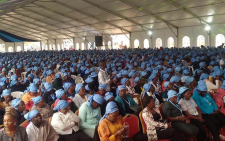
During the Idd-ul-Fitr luncheon at Kisumu State Lodge on March 20, 2026, Oburu commended the fund as a “very great idea,” noting it draws from successful international models rather than experimental approaches.
He expressed optimism that, with effective implementation, Kenya could achieve transformative growth, even aspiring to reach “Singapore in the coming years.”
National Infrastructure Fund
The NIF aims to mobilize approximately Ksh 5 trillion over the next decade for Vision 2030-aligned projects, shifting from heavy reliance on public debt to investment-backed financing with private sector involvement.
Key targets include constructing 2,500 km of dual carriageways, tarmacking 28,000 km of roads, extending the SGR from Naivasha to Malaba via Kisumu, generating 10,000 MW of clean energy, building 50 mega dams and over 1,200 smaller ones for irrigation, and modernising Jomo Kenyatta International Airport.
In the Lake region, these initiatives promise enhanced connectivity, reduced transport costs, boosted trade via Lake Victoria integration, and job opportunities in construction, logistics, and related sectors.
Oburu’s cross-party support signals potential unity on development and highlights the role of infrastructure in addressing historical marginalisation while fostering inclusive growth.
He noted that parliamentary oversight, Auditor-General audits, and independent governance would ensure transparent and impactful delivery.
Author
Latest News
Advertisement
More on News