Murkomen bets on restoring forests to heal Kerio Valley conflict
By Faith Lagat, May 21, 2026In the mist-covered slopes of the Cherangany Hills, where forests overlook the expansive Kerio Valley, Interior Cabinet Secretary Kipchumba Murkomen is advancing a conservation-driven approach linking environmental restoration and peacebuilding in a region long affected by insecurity and ecological pressure.
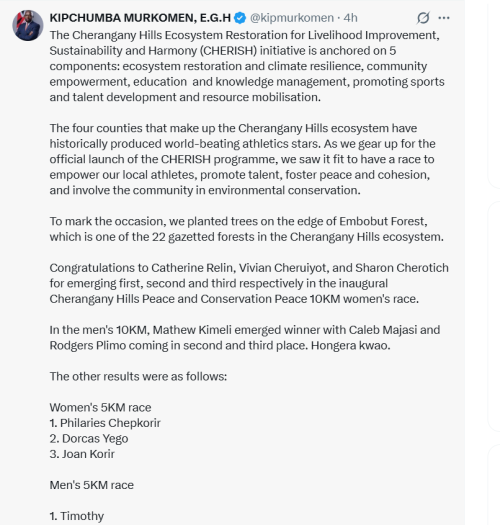
On Thursday, May 21, 2026, residents, athletes, conservationists and government officials gathered at Tebe Grounds in Kapyego Ward, Elgeyo Marakwet County, for the inaugural Cherangany Hills Peace and Conservation Race. The event was held ahead of the planned launch of the Cherangany Hills Ecosystem Restoration for Livelihood Improvement, Sustainability and Harmony (CHERISH) programme.
The initiative is a 10-year, Ksh15 billion programme that focuses on ecosystem restoration, livelihood creation and strengthening peacebuilding efforts in communities living around the Cherangany Hills ecosystem.
Murkomen said the programme is anchored on restoring degraded landscapes while addressing socio-economic challenges in the region.
“These hills made me who I am,” Murkomen said. “But I have watched this paradise slowly get degraded. The rains that were once predictable no longer are. Springs that once sang are now silent. Hillsides that were once green are now scarred. Rivers run heavy with silt. And where the forest once held the earth together, landslides now swallow homes and lives.”
He added that environmental changes have had direct effects on community relations and security.
“For too long, people have fought in the Kerio Valley because they lack basic resources. When rivers dry, when grazing lands shrink, and when there is no water for livestock, communities turn on each other. The cattle thief is often simply a young man whose environment has collapsed around him. Ecological destruction and insecurity are two sides of the same coin,” he stated.
This comes amid intensified peace and security operations in the Kerio Valley, where Murkomen revealed that government disarmament efforts have so far recovered over 2,000 illegal firearms, significantly weakening banditry networks and reducing immediate threats of armed violence.
The CHERISH programme targets restoration of more than 60,000 hectares of degraded land, rehabilitation of forests and wetlands, protection of 20 springs, and creation of approximately 500,000 green jobs through activities such as beekeeping, agroforestry and eco-tourism. It is also aligned with the national tree-growing campaign targeting 15 billion trees.
Kenya’s Ambassador and Permanent Representative to UNEP, Ida Odinga, who attended the event as chief guest, also emphasised the link between environmental restoration and peacebuilding.
“For too long, people have fought in the Kerio Valley because they lack basic resources. When rivers dry, when grazing lands shrink, and when there is no water for livestock, communities turn on each other. The cattle thief is often simply a young man whose environment has collapsed around him. This programme will help to address this challenge,” she said.
She noted that the Chesongoch landslide disaster highlighted the risks linked to environmental degradation and land-use pressure in the region.
Cherangany ecosystem faces pressure and degradation
The Cherangany Hills ecosystem spans Elgeyo Marakwet, West Pokot, Trans Nzoia and Uasin Gishu counties and forms part of Kenya’s major water towers. The forests within the ecosystem support key rivers including Kerio, Turkwel, Nzoia and Perkerra, which sustain agriculture, hydropower generation and millions of livelihoods across the country.
Between 1985 and 2020, forest cover in parts of the Cherangany ecosystem declined due to conversion of land for agriculture and settlement, as well as unsustainable land use practices. The resulting environmental stress has contributed to soil erosion, reduced water retention and increased vulnerability to landslides.
On October 31, 2025, heavy rainfall triggered landslides in Chesongoch, Elgeyo Marakwet County, resulting in more than 50 deaths and the displacement of hundreds of residents. The affected areas included Kasegei, Kwenoi, Kaptul and Kipkirwon.
According to officials, the steep terrain combined with loose volcanic soils and prolonged rainfall increased the severity of the disaster.
The Cherangany Hills are also home to indigenous communities, including the Sengwer and Marakwet, who have historically relied on forest resources and traditional conservation systems. The Marakwet furrows, an indigenous irrigation network, remain in use and continue to support farming activities along the escarpment.
Sports, conservation and community participation
The Peace and Conservation Race brought together athletes from across the Cherangany region, including Pokot and Marakwet communities, in an effort to promote unity and environmental awareness.
The women’s 10-kilometre race was won by Catherine Relin, followed by Vivian Cheruiyot and Sharon Cherotich. In the men’s category, Mathew Kimeli emerged winner, with Caleb Majasi and Rodgers Plimo finishing second and third respectively.

Olympic champion Faith Kipyegon served as race ambassador during the event, which also featured tree-planting activities at the edge of Embobut Forest.
Murkomen said the region’s strong athletics culture provides an entry point for conservation awareness and community mobilisation.
“The four counties that make up the Cherangany Hills ecosystem have historically produced world-beating athletics stars. We saw it fit to have a race to empower our local athletes, promote talent, foster peace and cohesion, and involve the community in environmental conservation,” he said.
Other government officials present included Environment Cabinet Secretary Deborah Barasa, Elgeyo Marakwet Governor Wisley Rotich and Principal Secretary Festus Ng’eno, alongside county commissioners and community representatives.
The official launch of the CHERISH programme is expected to take place at Embobut Forest, marking the beginning of long-term restoration, livelihood support and conservation efforts in the Cherangany Hills ecosystem.