Advertisement
Moses Kuria warns of anarchy if change is not well managed
Tuesday 02nd September, 2025 11:07 AM|

Former senior presidential economic adviser Moses Kuria has issued a stern warning, cautioning that Kenya is treading on dangerous ground if change is not carefully managed.
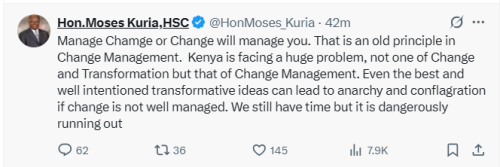
Speaking on the principles of transformation and governance on his X account on Tuesday, September 2, 2025, Kuria said that while reforms are necessary, they can quickly turn chaotic if leaders fail to handle them with wisdom and inclusivity.
He reminded the public of a timeless rule in change management: “Manage change or change will manage you.”
According to Kuria, Kenya’s challenge does not lie in the absence of bold or transformative ideas, but rather in the poor management of how such changes are introduced and executed. He stressed that without a deliberate and well-structured rollout, even the most promising reforms risk collapsing under the weight of confusion, resistance, and unintended consequences.. He warned that even the best-intentioned policies can spiral out of control if leaders push them without engaging citizens or considering their impact.

You Might Also Like



“Kenya is facing a huge problem, not one of change and transformation, but that of change management. Even the best and well-intentioned transformative ideas can lead to anarchy and conflagration if change is not well managed,” Kuria said.
His remarks come against the backdrop of heated public debates over major government programs and reforms, including digital systems, tax measures, and economic restructuring. Many Kenyans have voiced frustrations that policies are often rushed, with little regard for public participation or the readiness of institutions to implement them.
Kuria stressed that the country still has a window of opportunity to correct its course, but that time is running out.
“We still have time, but it is dangerously running out,” he said, underscoring the urgency of striking a balance between ambition and practicality.
Moses Kuria’s words reflect a growing concern among political leaders, economists, and civil society that Kenya’s reform agenda could face resistance if citizens continue to feel excluded. From protests over taxation to discontent about service delivery, signals of rising public frustration are becoming more visible.
For Kuria, the message is simple but critical: transformation must be managed with patience, consultation, and proper structures. Without that, the very changes meant to uplift the nation could ignite instability and unrest.
Author
Latest News




Advertisement
More on News