Kenya launches elite immigration crime unit to boost border security amid BATUK scrutiny
By Aloys Michael, July 25, 2026Kenya has launched a specialised Counter-Organised Immigration Crime Team (COICT) to strengthen the country’s fight against human trafficking, human smuggling and transnational organised crime, in a move that comes amid increased public scrutiny over Kenya-United Kingdom security cooperation following concerns surrounding the British Army Training Unit Kenya (BATUK).
The Director of Criminal Investigations (DCI), Mohamed Amin, officially flagged off the newly trained border security officers on behalf of Inspector General of Police Douglas Kanja at the Border Police Training Campus (BPTC) in Kanyonyoo, Kitui County, after they completed an intensive specialised training programme.
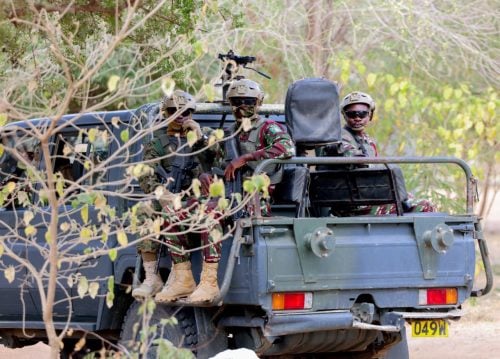
The elite unit comprises 29 officers drawn from across the National Police Service (NPS) and has been trained to investigate organised immigration crime, dismantle human trafficking and human smuggling syndicates, and counter other forms of transnational organised crime affecting Kenya’s borders.
The initiative is part of the Kenya–UK Border Security Programme, established under a Memorandum of Understanding signed earlier this year to strengthen border policing, intelligence sharing and coordinated action against cross-border criminal networks.
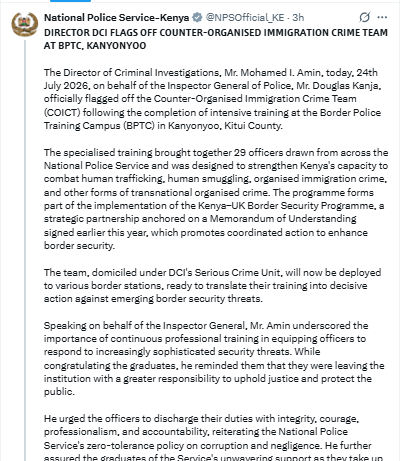
The officers, who will operate under the Directorate of Criminal Investigations’ Serious Crime Unit, are expected to be deployed to key border stations across Kenya to reinforce intelligence-led operations against increasingly sophisticated immigration crime networks.
Speaking on Friday, July 24, 2026, during the graduation ceremony, Amin said continuous professional training remains essential as criminal organisations adopt more complex methods to evade law enforcement.
“You are leaving this institution with a greater responsibility to uphold justice and protect the public,” he said.
Safeguarding borders
The DCI Director urged the officers to serve with “integrity, courage, professionalism and accountability,” while reiterating the National Police Service’s zero-tolerance policy on corruption and negligence.
He assured the graduates that the Service would provide unwavering institutional support as they assume their responsibilities in safeguarding Kenya’s borders and protecting national security.
Amin also described the Border Police Training Campus as “a centre of excellence” that continues to strengthen Kenya’s frontline preparedness by producing highly skilled officers capable of combating terrorism, organised immigration crime, human trafficking, human smuggling and other evolving cross-border threats.
He further thanked the United Kingdom Government and implementing partners for supporting Kenya’s efforts to strengthen border security capabilities through specialised training and technical assistance.
Representing the British High Commission, Ben Fisher praised the longstanding security partnership between Kenya and the United Kingdom, saying sustained cooperation had significantly strengthened both countries’ ability to respond to emerging security challenges.
He described the operationalisation of the Counter-Organised Immigration Crime Team as “a landmark achievement” and said it is “the first specialised capability of its kind in East Africa.”
Fisher congratulated the Government of Kenya and the National Police Service for swiftly establishing the specialised immigration crime unit, expressing confidence that it would significantly strengthen efforts to combat organised immigration crime across the region.
Also addressing the graduates, Administration Police Service Director of Security Operations Jackson Kangani, speaking on behalf of Deputy Inspector General Gilbert Masengeli, reminded the officers that their success would ultimately be judged by the results they deliver.
“The true success of the training will be measured not by the ceremony, but by its impact in the field, through lives protected, criminal networks dismantled, victims rescued, and safer communities,” Kangani said.
The Director of Criminal Investigations was received at the campus by Border Police Unit Commandant Davies Lomwatu and Border Police Training Campus Commandant Kiplangat Chirchir.
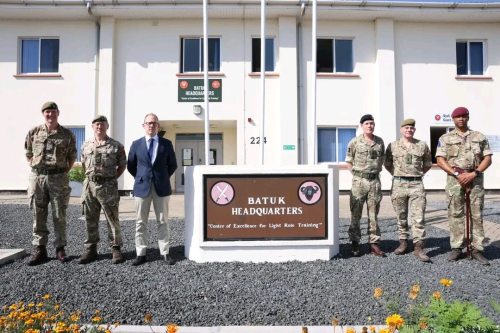
The launch of the specialised immigration crime investigators comes as Kenya continues to deepen security collaboration with the United Kingdom while facing increased public debate over aspects of the bilateral relationship, particularly following recent concerns surrounding BATUK. Although the Counter-Organised Immigration Crime Team operates independently of BATUK and is solely focused on combating organised immigration crime, the programme reflects ongoing cooperation between Nairobi and London in strengthening Kenya’s border security architecture and addressing shared transnational security threats.
Security experts have consistently identified organised immigration crime as one of the fastest-growing threats in East Africa, with criminal syndicates increasingly exploiting porous borders to facilitate human trafficking, migrant smuggling, document fraud and other illicit cross-border activities. Kenyan authorities believe the deployment of the newly trained officers will significantly enhance intelligence gathering, investigations and coordinated enforcement operations at key border points, ultimately improving public safety, dismantling criminal networks and reinforcing Kenya’s role as a regional leader in border security.