Kiunjuri weighs in on BATUK debate as Laikipia faces uncertainty over jobs, justice and future ties
By Wanjira Wachira, July 24, 2026As uncertainty continues to surround the future of the British Army Training Unit Kenya (BATUK), Laikipia East MP Mwangi Kiunjuri has added his voice to a conversation that has increasingly moved beyond military cooperation to touch on justice, livelihoods and the relationship between host communities and foreign institutions.
Speaking on Friday, July 24, 2026, during an economic empowerment meeting in Laikipia North, Kiunjuri called for greater benefits for communities hosting BATUK, respect for Kenya’s sovereignty and accountability in the unresolved murder of Agnes Wanjiru.
His remarks come at a time when BATUK is under renewed public scrutiny following the relocation of the 2026 Exercise Haraka Storm outside Kenya after delays in renewing the Kenya-United Kingdom Defence Cooperation Agreement. The development has triggered fresh conversations in Laikipia, where many businesses depend on the economic activity generated by British military exercises.
A partnership at a crossroads
For decades, BATUK has maintained a presence in Laikipia and Samburu, with thousands of British troops travelling to Kenya annually for training exercises.
The partnership has supported businesses in Nanyuki and surrounding towns, where hotels, transport providers, suppliers, restaurants and other enterprises have grown around military activities. At the same time, it has also attracted criticism over environmental concerns, compensation claims and questions surrounding accountability for incidents involving British soldiers.
The latest uncertainty followed the cancellation and relocation of Exercise Haraka Storm, one of BATUK’s major annual exercises. The move, linked to delays in renewing the bilateral defence agreement, has left many residents wondering what the future holds for an institution that has long been part of the region’s economy.
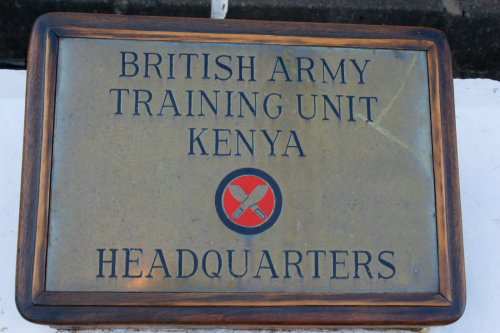
For some businesses, the cancelled exercise represents lost income. For others, it has reopened a broader conversation about whether local communities have fully benefited from BATUK’s presence over the years.
A case that continues to resonate
Among the issues that continue to shape public debate is the death of Agnes Wanjiru.
The 21-year-old disappeared in Nanyuki in 2012 after she was reportedly last seen with British soldiers. Her body was later recovered from a septic tank at a local hotel. The case has remained unresolved despite investigations in both Kenya and the United Kingdom and has become one of the most sensitive issues in discussions surrounding BATUK.
While addressing residents, Kiunjuri argued that because Wanjiru was a Kenyan and died in Kenya, the country’s justice system should handle the matter.
“You cannot give condition in other people’s land. Our sovereignty as Kenyans must be respected.”
He then led the audience in a call-and-response over where those responsible should face trial.
“Mliua Mkenya akiwa Kenya. Washitakiwe wapi? Kenya! Washitakiwe hawa watu wapi? Kenya! Mliua wapi? Kenya! Mliua Mkenya, washitakiwe wapi? Kenya!”
The remarks reflected his view that crimes committed on Kenyan soil should be addressed through Kenyan courts.
Sharing the benefits locally
Beyond the question of justice, Kiunjuri urged institutions operating in Laikipia to strengthen their relationship with the communities that host them.
He said local leaders have a responsibility to ensure residents benefit whenever opportunities arise from investments in the county.
“Hao wenyeji ndio wanalia zaidi. Hao wenyeji ndio wametutuma tuhakikishe kwamba kama ni kazi zinapatikana, wote wapate kazi kwanza.”
The MP also spoke about the wider economic opportunities created by BATUK’s presence, saying local businesses should be part of that value chain.
Rather than focusing solely on direct employment, he suggested that everyday spending by visiting personnel—from accommodation and meals to other services—should increasingly benefit businesses owned by residents of Laikipia.
Kiunjuri further encouraged institutions operating in the county to deepen their corporate social responsibility programmes so that host communities experience more visible and lasting benefits.
Despite raising concerns, Kiunjuri emphasised that Laikipia remains open to investment and partnerships.
“Tunawapenda, kujeni, kaeni na sisi, lakini mtuheshimu.”
He also acknowledged that some local residents have secured employment through BATUK and other organisations operating in the area, saying the goal was not to oppose investment but to ensure that communities living alongside such institutions continue to share in the opportunities they create.
His remarks add to a growing national conversation that has intensified in recent months as Kenya and the United Kingdom continue discussions on a new defence cooperation framework.
For residents of Laikipia, the debate is about more than diplomacy. It is about balancing the economic opportunities that BATUK has brought over the years with expectations of accountability, respect for Kenyan institutions and greater inclusion of the communities that have hosted the military training unit for generations.
As negotiations over the future of the defence partnership continue, leaders, businesses and residents alike are watching closely, hopeful that whatever agreement emerges will preserve livelihoods while addressing long-standing concerns over justice and community participation.