Advertisement
Kenya gives fresh proposal on tackling methane emissions to save humanity
Tuesday 05th May, 2026 06:56 PM|

Kenya has called on African countries to adopt a unified and equitable approach to reducing methane emissions, emphasising the need to balance climate action with the protection of livelihoods for pastoralists and smallholder farmers across the continent.
The position was presented during a joint virtual session of the Senate and the National Assembly held under the Regional Seminar for African Parliaments on Climate Action on Tuesday, May 5, 2026.
The meeting, chaired by Mombasa Senator Mohamed Faki, brought together legislators, experts, and stakeholders to develop a common African parliamentary position on methane mitigation and sustainable development.
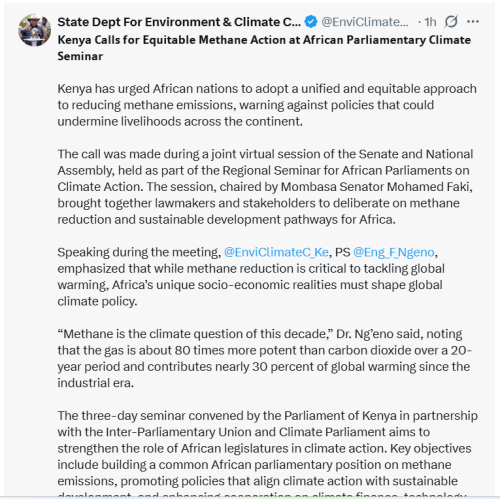
“Kenya has urged African nations to adopt a unified and equitable approach to reducing methane emissions, warning against policies that could undermine livelihoods across the continent,” read the X post in part.
Kenya outlines methane and climate position
You Might Also Like


Principal Secretary in the State Department for Environment and Climate Change, Festus Ng’eno, described methane as “the climate question of this decade.”
Methane is the second-largest contributor to global warming after carbon dioxide and remains in the atmosphere for a shorter period, but it is approximately 80 times more potent than carbon dioxide over a 20-year period. It has contributed nearly 30 per cent of global warming since the industrial era.
Ng’eno noted that Africa contributes a small share of global greenhouse gas emissions but faces severe climate impacts, including droughts, floods, food insecurity, and displacement.
Kenya’s emissions account for less than 0.1 percent of global totals, with methane largely originating from livestock enteric fermentation, which contributes about 96 percent of national methane output, and waste management systems.
Calls for equity in climate policy
Ng’eno said emission trends during crisis periods should not be misinterpreted as progress, citing reduced livestock emissions during the 2022 drought that resulted in significant animal losses.
“That is not a climate success. That is a climate emergency,” he said.
He stated that methane reduction strategies must align with the principles of equity under Article 2 of the Paris Agreement. “Policies aimed at reducing methane emissions must not compromise the livelihoods of pastoralists, smallholder farmers, or rural households,” Ng’eno said. “Africa will not pay for this crisis with her people’s livelihoods.”
Climate action and regional cooperation
Kenya outlined ongoing mitigation efforts, including the installation of more than 21,000 household biogas digesters since 2009, with a target of 80,000 units to support clean energy transition. The country is also implementing the National Cooking Transition Strategy aimed at achieving universal clean cooking access by 2028.
Additional measures include improved waste management systems to capture methane emissions, expansion of ecosystem restoration under the Presidential 15 Billion Trees initiative, and efforts to enhance livestock productivity to reduce emissions intensity.
The three-day seminar, organised by the Parliament of Kenya in partnership with the Inter-Parliamentary Union and Climate Parliament, focuses on strengthening legislative roles in climate governance, enhancing climate finance mobilisation, and promoting technology transfer across African countries.
Ng’eno was accompanied by NETFUND CEO Samson Toniok and Parliamentary Liaison Officer Rodney Omari, among other officials. African legislators were urged to align international climate commitments with domestic policies that support both environmental sustainability and socio-economic resilience.
Author
Latest News





Advertisement
More on News