Advertisement
HELB, KUCCPS funding at risk amid budget cuts
Friday 15th May, 2026 02:35 PM|

Concerns are growing over the future of higher education financing in Kenya after the National Assembly Education Committee raised alarm over major funding shortfalls affecting universities, TVET institutions, research programmes, and student support agencies, including the Higher Education Loans Board (HELB) and the Kenya Universities and Colleges Central Placement Service (KUCCPS).
Members of the Education Committee warned that the proposed 2026/2027 budget allocations could disrupt access to higher education, weaken research and innovation programmes, and affect the sustainability of public universities and technical institutions.
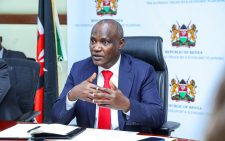
Appearing before the committee on Friday, May 15, 2026, State Department for Higher Education Principal Secretary Beatrice Inyangala said the department had requested Ksh 311.9 billion for recurrent expenditure and Ksh 11.4 billion for development projects.
However, the proposed estimates allocated Ksh 155.2 billion for recurrent expenditure and Ksh 8.9 billion for development, leaving a substantial funding deficit.
You Might Also Like

The department oversees 43 public universities as well as agencies including HELB and KUCCPS. The allocations are expected to support university scholarships, student loans, placement services, and the implementation of the new higher education funding model.
Inyangala told the committee that although funding for student loans and scholarships had increased slightly, the broader cuts would affect the implementation of key programmes.
TVET sector also faces financial pressure
The State Department for Technical and Vocational Education and Training also raised concerns over inadequate funding for TVET institutions and student support programmes.
Principal Secretary Esther Muoria said the department requires an additional Ksh 19.162 billion for student scholarships. She warned that failure to secure the funds could increase pending bills, expose institutions to legal disputes, and contribute to higher student dropout rates.
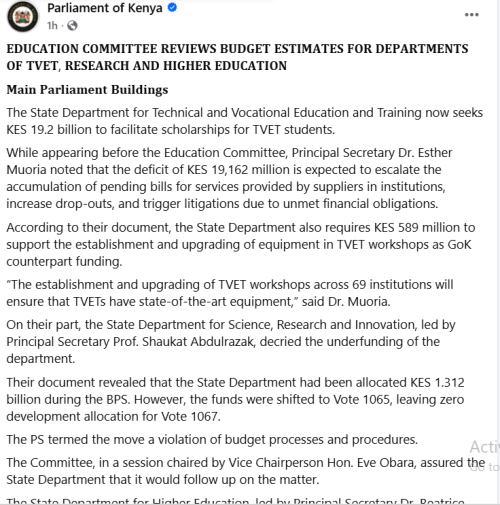
The department is also seeking Ksh 589 million in counterpart funding to support the upgrading and equipping of workshops in 69 TVET institutions.
“The establishment and upgrading of TVET workshops across 69 institutions will ensure that TVETs have state-of-the-art equipment,” Muoria said.
Lawmakers heard that improved facilities are expected to strengthen practical training and align technical education with labour market demands.
Research institutions affected by reallocations
The State Department for Science, Research and Innovation also expressed concern after development funds initially included in the Budget Policy Statement were reportedly reallocated elsewhere.
Principal Secretary Prof Shaukat Abdulrazak told the committee that although Ksh 1.312 billion had been proposed for development expenditure, the allocation was later moved to another vote, leaving the department without development funding for core programmes.
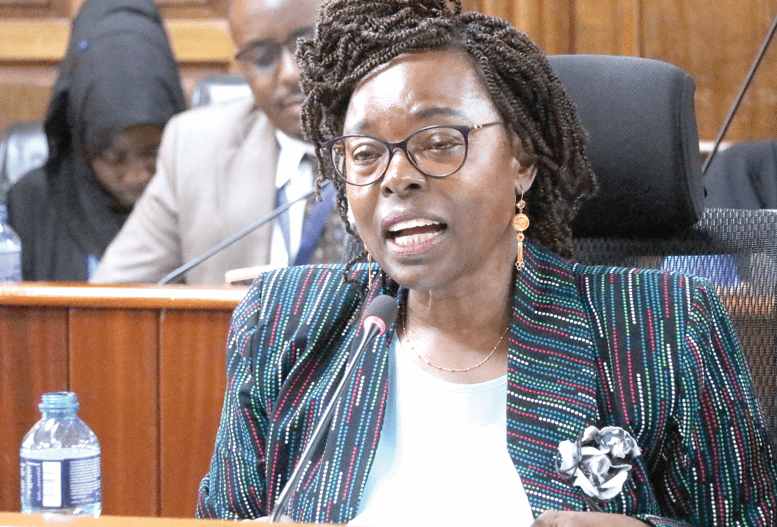
The Education Committee, chaired during the session by Vice Chairperson Hon Eve Obara, assured the three state departments that it would follow up on the reallocations and seek corrective measures before the budget is finalised.
The discussions come as education stakeholders continue to monitor the impact of budget constraints on university funding, technical training, research programmes, and student financing ahead of the next academic year.
Author
Latest News





Advertisement
More on News