Advertisement
Health ministry pushes bold plan to speed up Kenya’s local vaccine manufacturing
Wednesday 19th November, 2025 03:57 PM|

Kenya’s vision of producing its own vaccines received renewed energy this week after the Ministry of Health held a high-level meeting with the leadership of KEMSA and the Kenya Biovax Institute.
The discussion comes at a time when the country continues to push for stronger health security, reliable medical supplies and reduced dependence on foreign manufacturers.
The ministry said in a statement shared on X on Wednesday, November 19, 2025, the meeting was part of a wider effort to bring different health agencies together in order to fast-track local production and ensure that Kenyans can access life-saving vaccines without delays or shortages.
Officials described the engagement as timely and necessary, coming at a moment when global supply chains remain unpredictable and costly for developing nations.

You Might Also Like

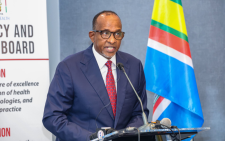

“On 19 November 2025, Principal Secretary for Medical Services, Ouma Oluga, met the CEOs of KEMSA and the Kenya Biovax Institute to discuss priority actions to accelerate local vaccine manufacturing and strengthen Kenya’s health-commodity supply chain,” the statement noted that this dialogue was meant to align the work of different institutions toward one shared goal, a stronger, self-reliant health system.
The ministry also highlighted the importance of coordinated distribution systems, particularly KEMSA’s role in ensuring vaccines produced locally reach every corner of the country.
It stated that “The engagement focused on enhancing collaboration, particularly KEMSA’s role in ensuring efficient distribution systems and expanding access to locally produced vaccines,” the statement reads
Oluga say the plan is not only about manufacturing but also about building confidence in Kenya’s long-term ability to secure essential medical commodities for its population.
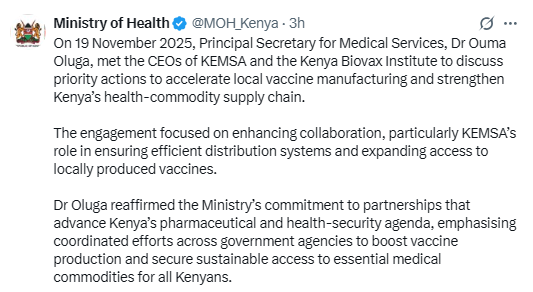
“Oluga reaffirmed the Ministry’s commitment to partnerships that advance Kenya’s pharmaceutical and health-security agenda, emphasising coordinated efforts across government agencies to boost vaccine production and secure sustainable access to essential medical commodities for all Kenyans,” the statement reads
By reducing reliance on global suppliers, the government hopes to shorten delivery times, cut costs and ensure the country is better prepared for future health emergencies.
The ministry has indicated that these engagements will continue, with a focus on long-term planning, investment and building technical capacity. The goal is to ensure that Kenya not only manufactures vaccines but also creates a sustainable system that supports local innovation and protects public health for generations to come.
Author
Latest News







Advertisement
More on News