Advertisement
Govt pushes ahead with 10-point agenda implementation
Monday 12th January, 2026 07:42 PM|

The government has stepped up efforts to implement the 10-Point Agenda and the National Dialogue Committee (NADCO) report, with a clear focus on meeting the March 2026 deadline.
Head of Public Service Felix Koskei received a detailed briefing from the Committee on Implementation during a courtesy call at his office on Monday, January 12, 2025.
The committee updated Koskei on the concrete steps it has taken since its first meeting in November 2025. Members outlined plans to hold consultative forums that will bring together state agencies, civil society groups, and other stakeholders. These forums aim to gather views, build consensus, and avoid delays as the government moves from agreements to action.
The committee also presented a memorandum guide to Koskei. The document sets out specific areas where his office must provide responses to support the rollout of the 10-Point Agenda. Similar guides will soon go to other government agencies involved in the process.
You Might Also Like
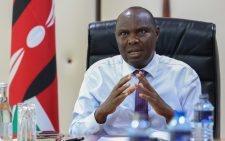
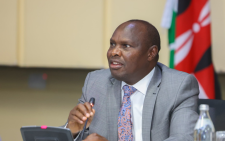
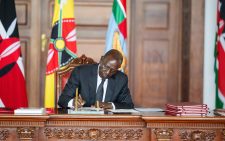
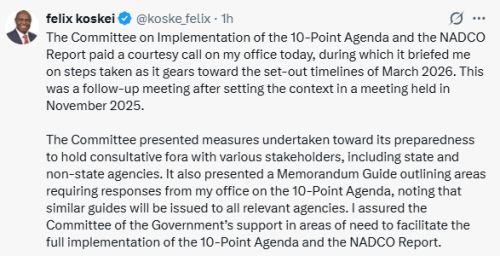
“The Committee presented measures undertaken toward its preparedness to hold consultative forums with various stakeholders, including state and non-state agencies,” Koskei posted on his X account.
“It also presented a memorandum guide outlining areas requiring responses from my office on the 10-point agenda, noting that similar guides will be issued to all relevant agencies.”
Koskei assured the team of full government support. He pledged to remove any obstacles that could slow implementation and said his office would provide the coordination and resources needed to deliver the agenda and the NADCO recommendations in full.
The 10-Point Agenda arose from the agreement between President William Ruto and the late Raila Odinga. The deal followed months of political tension and protests, which led to the formation of the National Dialogue Committee.
Parliament later adopted the NADCO report, which proposed reforms such as the creation of the Office of the Leader of the Opposition, stronger political parties, and improvements to electoral processes.
Agenda implementation
The implementation committee now carries the responsibility of turning these proposals into reality. It works across government, sets timelines, and tracks progress. The March 2026 deadline remains the key target, with regular meetings used to review progress and maintain momentum.
Koskei described the process as central to building a more inclusive and stable Kenya. He said implementation would help restore trust by showing that political agreements can lead to real change.

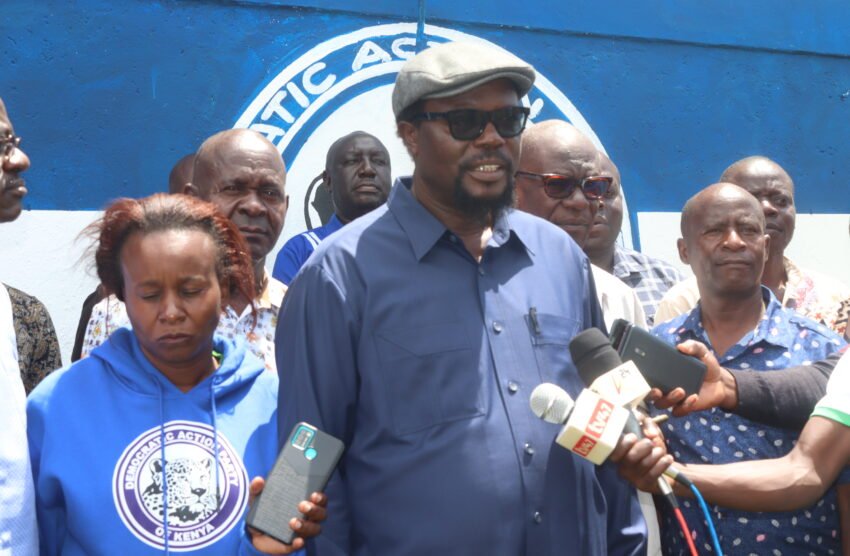
These government efforts come as political parties also prepare for the next phase of engagement. On the same day, the Orange Democratic Movement (ODM) announced plans to begin structured talks with other political groups ahead of the 2027 general election. The decision followed a Central Management Committee meeting in Kilifi County.
ODM leader Oburu Oginga will lead the talks, starting with President Ruto’s United Democratic Alliance (UDA). The party said the discussions would involve members and feed into a future National Delegates Convention. ODM aims to strengthen its organisation, refine policy positions, and prepare for coalition building.
ODM also reviewed progress on its own ten-point agenda, including compensation for victims of public protests. After courts ruled out a proposed panel of experts, the party agreed to channel funds through lawful bodies such as the Kenya National Commission on Human Rights.
Author
Kenneth Mwenda
Kenneth Mwenda is a business, sports, and politics digital writer with over seven years of experience in journalism, covering breaking news, feature stories, and in-depth analysis across a range of beats.
For inquiries, he can be reached at [email protected]
View all posts by Kenneth MwendaLatest News


Advertisement
More on News