Faith Odhiambo explains constitutional process amid Finance Bill 2026 submissions
By Faith Lagat, May 12, 2026Former Law Society of Kenya President Faith Odhiambo has outlined the constitutional basis for public participation in law-making as Parliament opens submissions on the Finance Bill 2026.
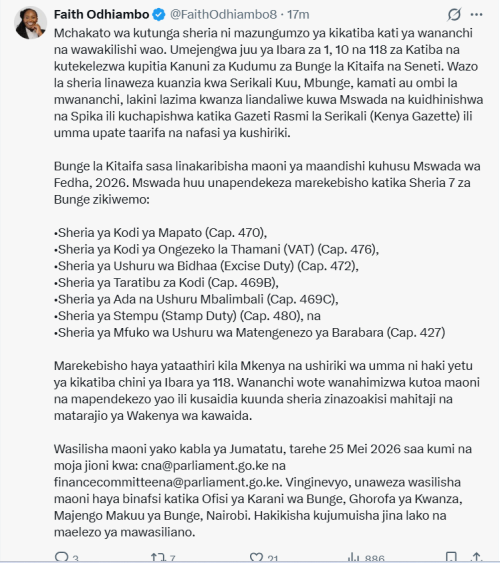
In a post dated May 12, 2026, Odhiambo described the legislative process as “a constitutional dialogue between citizens and their representatives,” anchored in Articles 1, 10 and 118 of the Constitution and implemented through the Standing Orders of the National Assembly and Senate.
“Mchakato wa kutunga sheria ni mazungumzo ya kikatiba kati ya wananchi na wawakilishi wao,” she stated. “Umejengwa juu ya Ibara za 1, 10 na 118 za Katiba na kutekelezwa kupitia Kanuni za Kudumu za Bunge la Kitaifa na Seneti.”
Odhiambo further explained that any legislative proposal, whether originating from the Executive, a Member of Parliament, a committee or a citizen petition, must be drafted into a Bill, approved by the Speaker, and published in the Kenya Gazette to allow public engagement before enactment.
Finance Bill 2026 public participation process
The National Assembly has invited written memoranda on the Finance Bill 2026, which has been committed to the Departmental Committee on Finance and National Planning after its introduction by Molo MP Kuria Kimani.
The Bill proposes amendments to seven laws: the Income Tax Act (Cap. 470), Value Added Tax Act (Cap. 476), Excise Duty Act (Cap. 472), Tax Procedures Act (Cap. 469B), Miscellaneous Fees and Levies Act (Cap. 469C), Stamp Duty Act (Cap. 480), and the Kenya Roads Board Act (Cap. 427).
According to Parliament, the proposals aim to streamline tax administration, update outdated provisions, and widen the tax base without introducing new tax rates.
Key measures include expanded definitions of royalties to include digital platforms and payment systems subject to withholding tax, new reporting requirements for virtual asset service providers, and a reduction of the income tax return filing period from six to four months.
Additional provisions include VAT exemptions for dialysers and public-private partnership projects, reclassification of selected goods such as electric buses and mobile phones, and excise duty adjustments, including a 25 per cent levy on mobile phones, new charges on plastic packaging and coal, and revised contributions to the Road Maintenance Levy.
Stakeholder response and compliance concerns
Treasury Cabinet Secretary John Mbadi has stated that the measures are designed to enhance compliance and broaden the tax base while maintaining existing rates. However, professional bodies and tax experts have raised concerns over increased compliance requirements, possible double taxation on digital transactions, and shortened filing timelines.
Law firm Bowmans noted that the proposed changes could increase administrative obligations for businesses and digital service providers, particularly in cross-border transactions and virtual asset operations.
Public participation submissions timeline
Kenyans and stakeholders have been invited to submit written views by Monday, May 25, 2026, at 5:00 pm. Submissions can be sent to cna@parliament.go.ke and financecommitteena@parliament.go.ke, or delivered to the Office of the Clerk of the National Assembly at Parliament Buildings, Nairobi.
Odhiambo emphasised that public participation under Article 118 remains a constitutional requirement in the legislative process, ensuring citizens contribute to shaping laws that affect taxation, governance and public administration.