Advertisement
National Assembly invites public views on Finance Bill 2026 as tax changes spark debate
Monday 11th May, 2026 07:08 AM|

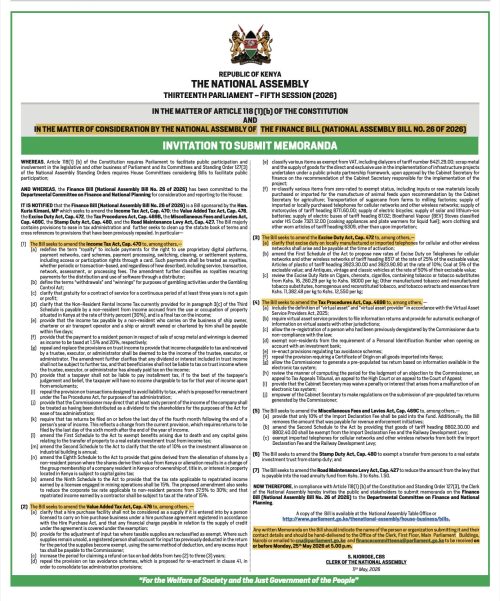
The National Assembly has invited Kenyans and stakeholders to submit views on the Finance Bill 2026, opening public participation on a wide-ranging proposal that seeks to amend several tax laws and change how taxes are administered in the country.
In a notice issued on Monday, May 11, the Clerk of the National Assembly, Samuel Njoroge, said the Bill had been committed to the Departmental Committee on Finance and National Planning for consideration before debate in the House.
The proposed law, sponsored by Molo MP Kuria Kimani, seeks to amend laws including the Income Tax Act, Value Added Tax Act, Excise Duty Act, Tax Procedures Act, Stamp Duty Act and the Road Maintenance Levy Act.
Parliament said the bill mainly aims to ease tax administration and clean up outdated provisions and references in existing laws. However, several proposals have already triggered concern from tax experts and businesses over the possible impact on consumers and investors.
Major changes
You Might Also Like



Among the major changes is a proposal to expand the definition of royalties to include payments linked to digital platforms, payment processing systems, card schemes and settlement networks. The proposal would subject such payments to withholding tax.
The bill also seeks to introduce new tax reporting obligations for virtual asset service providers, including cryptocurrency platforms, in line with the Virtual Asset Service Providers Act, 2025.
Another proposal would reduce the deadline for filing income tax returns from six months after the end of the financial year to four months. Taxpayers with no income other than employment income would also be exempted from paying instalment tax if they reasonably expect not to have taxable income during the year.
The Finance Bill further proposes changes in the taxation of winnings from gambling activities, non-resident rental income, trust income and capital gains involving foreign investors with interests in Kenya.
On VAT, the bill proposes to exempt some goods, including dialysers and goods imported for approved public-private partnership infrastructure projects. It also seeks to reclassify several items from zero-rated to VAT-exempt status, including electric buses, some animal feed inputs and cellular telephones.
The proposed changes to the Excise Duty Act include a 25 per cent excise duty on mobile phones, new levies on plastic packaging materials and coal, and higher excise rates on tobacco products.
Treasury Cabinet Secretary John Mbadi had earlier told Parliament that the government would not introduce new taxes or raise existing tax rates in the 2026 Finance Bill. Instead, he said the government would focus on widening the tax base and improving compliance through automation at the Kenya Revenue Authority (KRA).
Despite those assurances, some analysts argue that several proposals in the bill could still increase the cost of doing business.
Businesses raise tax concerns
Pan-African law firm Bowmans recently warned that the proposals may create a heavier compliance burden for businesses, especially in digital payments, fintech and property sectors.
The firm said the proposed withholding tax rules on merchant service fees and digital payment systems could result in double taxation.
“This amendment will likely result in additional compliance burden for businesses that will be required to deduct and remit withholding tax on the merchant service fee,” Bowmans said in its review of the draft bill.
The law firm also criticised the shortening of tax filing timelines, warning that companies would need to deploy more resources to comply with the new deadlines.
Bowmans further raised concern over proposals allowing the KRA to issue agency notices to banks and third parties even when tax disputes are still before tribunals or courts.
However, the firm welcomed some reforms, including clarification on trust taxation and measures allowing the Cabinet Secretary to waive penalties caused by failures in electronic tax systems.
The Finance Bill also contains proposals affecting imports. Imported mobile phones would be exempt from the Import Declaration Fee and Railway Development Levy, while aircraft under certain tariff categories would also receive exemptions.
In addition, the bill seeks to reduce the amount paid from the Road Maintenance Levy into the road annuity fund from Ksh3 to Ksh1.50.
Parliament has now called on members of the public, organisations and other stakeholders to submit written memoranda on the Bill before Monday, May 25, 2026, at 5 pm.
Submissions can be hand-delivered to the Office of the Clerk at Parliament Buildings in Nairobi or emailed to [email protected] and [email protected].
A copy of the Finance Bill 2026 is available through the National Assembly of Kenya.
Author
Kenneth Mwenda
Kenneth Mwenda is a business, sports, and politics digital writer with over seven years of experience in journalism, covering breaking news, feature stories, and in-depth analysis across a range of beats.
For inquiries, he can be reached at [email protected]
View all posts by Kenneth MwendaLatest News







Advertisement
More on News