Advertisement
Europe plans full border closure to fight Covid-19
Tuesday 17th March, 2020 12:00 AM|
Paris, Tuesday
The European Commission is planning to ban all non-essential travel throughout Europe’s Schengen free-travel zone as more countries close their borders to try to limit the spread of coronavirus.
Commission President Ursula von der Leyen said she would ask leaders to implement the measures on Tuesday.
“The less travel, the more we can contain the virus,” she said.
You Might Also Like

The number of novel coronavirus cases globally stood at more than 173,000 with 7,063 deaths, across 145 countries and territories as at Tuesday.
Meanwhile in France, President Emmanuel Macron announced tough new measures requiring people in the country to remain home.
The lockdown prohibits all but essential outings in a bid to curb the coronavirus spread.
Macron said the previous measures, including the closing of schools, cafes and non-essential shops, had proved insufficient.
“Even while medics were warning about the gravity of the situation, we saw people get together in the parks, busy markets and restaurants and bars that did not respect the order to close,” he said.
“We are at war… we’re fighting neither another army nor our own nation. But the enemy is here, invisible, untouchable… and is advancing,” he said.
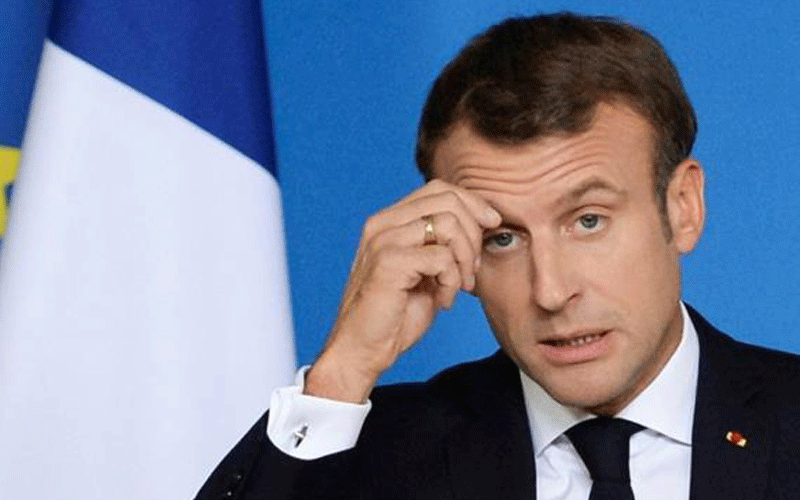
The EU measures were alluded to in Macron‘s televised address to his nation when he revealed that “all trips between non-European countries and EU countries will be suspended”.
Von der Leyen said that long-term residents, family members of EU nationals and diplomats would be exempt as well as cross-border and healthcare workers and people transporting goods.
Border checks
The measures would be in place for at least 30 days. The Schengen agreement allows people to move freely between EU countries without border checks.
Citizens of non-Schengen EU member states will also be invited to apply the travel ban.
The comments came ahead a video-summit with EU leaders on Tuesday hosted by European Council chief Charles Michel.
Deaths from coronavirus in Spain surged to 491 on Tuesday from 309 the day before, health officials have said.
The number of confirmed cases also soared by 2,000 to 11,178, as Spain closed its borders and maintained a partial lockdown on 47 million people.
Death tolls have increased elsewhere, with Iran reporting 135 more, taking its official total close to 1,000.
The country has curtailed celebrations for a fire festival in a bid to contain the disease.
British nationals were directed to avoid all non-essential foreign travel. The travel restrictions will be in place for 30 days initially but could be extended.
The UK Parliament is considering making changes to protect its staff. Visitors have already been banned from the historic building, but business for MPs is, for the moment, carrying on as normal.
The Clerk of the House of Commons has written to the Procedure Committee suggesting a number of possible moves that could come into force in the coming weeks or months.
They include, using video-conferencing; Allowing MPs to ask questions on behalf of others; deciding votes on voices, not going through voting lobbies; reducing the number of staff in the Commons and limiting the number of written questions MPs can submit.
In Italy, the government will rush 10,000 student doctors into service, scrapping their final exams, in an effort to help the struggling health service cope with the coronavirus onslaught.
The worst-hit nation after China is Italy with 2,158 deaths (27,980 cases), Iran with 853 fatalities (14,991 cases), Spain with 309 deaths (9,191 cases) and France with 148 deaths (6,633 cases). -BBC and AFP
Author
People Daily
View all posts by People DailyLatest News




Advertisement
More on News