Advertisement
Duale confirms no Ebola reported in Kenya as 56 suspected cases test negative
Friday 05th June, 2026 11:09 PM|
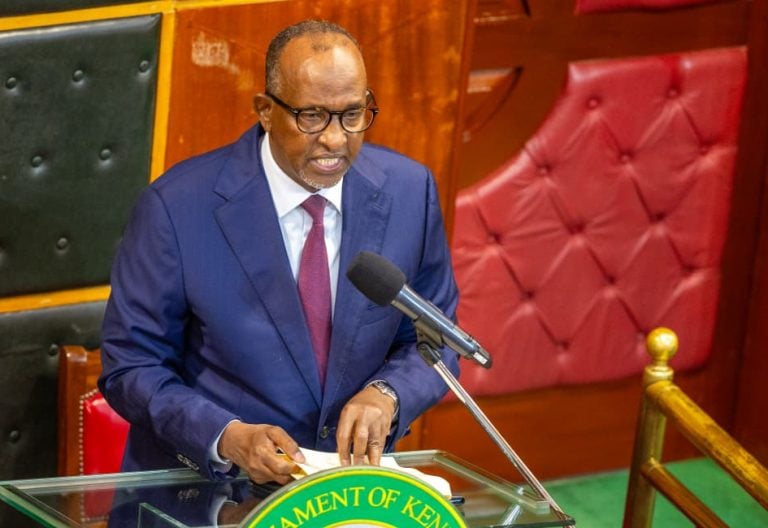
Health Cabinet Secretary Aden Duale has confirmed that Kenya remains free of Ebola Virus Disease after all 56 suspected samples tested negative, easing public concern even as authorities maintain heightened surveillance due to regional outbreaks.
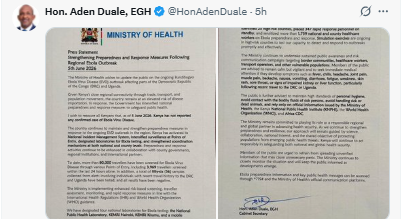
In a statement on Friday, June 5, 2026, Duale said the country has not recorded any confirmed case of Ebola, despite increased monitoring following outbreaks in neighbouring Uganda and the Democratic Republic of the Congo, adding that the Ministry of Health (MoH)continues to strengthen preparedness systems to reduce the risk of importation.
“Kenya has not reported any confirmed case of Ebola Virus Disease. The country continues to maintain and strengthen preparedness measures in response to the ongoing outbreak in the region,” the statement read in part.
The CS has said surveillance has been intensified at all major points of entry, including airports, seaports, and land border crossings, as part of efforts to detect and isolate any potential cases early.
You Might Also Like


Since the enhanced surveillance measures were introduced, more than 80,000 travellers have been screened for symptoms consistent with Ebola or related exposure risks.
In the last 24 hours alone, 3,969 travellers were screened, reflecting what officials describe as sustained vigilance amid regional health threats.
MoH also confirmed that 56 samples collected from individuals flagged through surveillance systems were tested in designated laboratories and all returned negative results.
The government said the individuals tested were mainly identified due to recent travel history to affected areas in Uganda and the Democratic Republic of the Congo (DRC), where Ebola outbreaks linked to the Bundibugyo strain have been reported.
Duale insisted that while no cases have been detected in Kenya, the country remains at an elevated risk due to its strong cross-border movement of people, goods, and services.
To enhance preparedness, Duale said the government has activated the National Incident Management System and strengthened coordination between national and county health authorities.

Four key laboratories have been designated for Ebola testing: the National Public Health Laboratory, KEMRI Nairobi, KEMRI Kisumu, and a mobile laboratory stationed at the Busia One-Stop Border Post.
In addition, 347 rapid response personnel have been placed on standby, while more than 1,700 healthcare workers across the country have been trained in Ebola detection, prevention, and response. Simulation exercises are also ongoing in high-risk counties to test readiness and improve response times in case of an outbreak.
The ministry is further conducting public awareness campaigns targeting border communities, transport operators, and healthcare workers.
MoH has urged Kenyans to observe proper hygiene, avoid contact with the bodily fluids of suspected cases, and seek immediate medical attention if symptoms such as fever, vomiting, diarrhoea, or unexplained bleeding occur.
Duale cautioned against misinformation and urged the public to rely only on official updates from the Ministry of Health, the Kenya National Public Health Institute, the World Health Organisation (WHO), and Africa CDC.
Author
Latest News




Advertisement
More on News