Advertisement
COTU defends ongoing NSSF deductions despite court ruling
Saturday 06th June, 2026 05:31 PM|

The Central Organisation of Trade Unions (COTU-K) has defended the continued deduction and remittance of National Social Security Fund (NSSF) contributions under the current enhanced rates, saying workers and employers must remain compliant despite ongoing legal uncertainty surrounding the NSSF Act, 2013.
In a statement issued on Saturday, June 6, 2026, COTU said Kenyan workers will continue contributing under the framework set out in the NSSF Act, 2013, which it insists remains valid following earlier Court of Appeal directions.
“As the umbrella body representing Kenyan workers, we wish to inform the public that, as Kenyan workers, we shall continue contributing under the enhanced contribution framework provided for under the NSSF Act, 2013, which, in our view, remains valid and enforceable by dint of the judgment delivered by the Court of Appeal on 3rd February, 2023,” the union said through Secretary General Francis Atwoli.
Court rulings fuel confusion in pension sector
COTU’s statement comes after renewed debate triggered by a Court of Appeal decision delivered on May 29, 2026, which declined to suspend an earlier judgment that had declared parts of the NSSF Act, 2013 unconstitutional.
You Might Also Like


In its ruling on the application for stay orders, the Court found that the NSSF Board of Trustees failed to provide sufficient evidence to justify suspending the earlier decision that had declared the law unconstitutional at the Employment and Labour Relations Court (ELRC).
The judges noted that claims of a legal vacuum were not adequately supported, stating that the previous NSSF framework (Cap 258) remains operational in law, meaning contributions cannot be said to exist in a regulatory void.
As the court observed in its findings, “the applicant provided no evidence” to support claims that the Fund would suffer irreparable harm if the enhanced contribution structure was not suspended.
The bench further held that although the appeal raises important legal questions, including the role of the Senate in enacting the NSSF Act 2013, there was no justification for halting the current pension contribution system before the substantive appeal is heard.

A three-judge bench comprising Justices Wanjiru Karanja, Kathurima M’Inoti and Pauline Nyamweya ruled that the matter remains pending determination on merit, meaning the legal validity of enhanced deductions is still under judicial review.
NSSF Act 2013 dispute
The dispute originates from a September 19, 2022 ELRC judgment, which declared the NSSF Act, 2013 unconstitutional and null and void. The court cited several constitutional concerns, including lack of Senate participation and conflicts with existing pension arrangements.
The ELRC found that the law was enacted without proper constitutional processes and that it compelled workers to contribute to NSSF even where they were already part of private pension schemes.
However, the National Social Security Fund (NSSF) appealed the ruling, arguing that the Act is a contributory pension scheme under Article 43 of the Constitution and is necessary to strengthen long-term retirement savings in Kenya.
The Fund has consistently warned that reversing the current structure would reduce retirement savings significantly, stating in earlier submissions that Kenyan workers benefit because “their employers match what they save,” a mechanism intended to reduce old-age poverty.
COTU-Kenya position
The Central Organisation of Trade Unions (COTU-K) has maintained that workers and employers must continue remitting contributions under the existing framework, arguing that the current court processes do not suspend the law in force.
COTU has also urged employers to comply fully with statutory obligations, warning that failure to remit contributions could undermine workers’ retirement security.
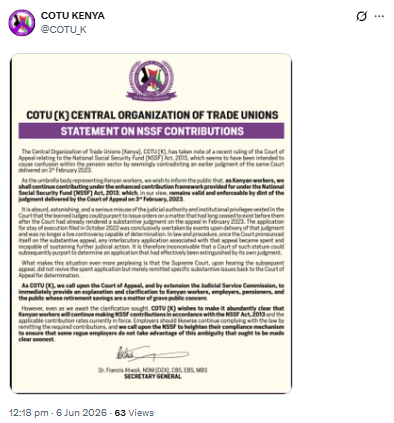
As the union stated in its clarification, employers must continue contributing and ensure full compliance, adding that the NSSF should strengthen enforcement to prevent exploitation of legal ambiguity.
“Employers should likewise continue complying with the law by remitting the required contributions, and we call upon the NSSF to heighten their compliance mechanism to ensure that some rogue employers do not take advantage of this ambiguity that ought to be made clear soonest,” the statement added.
COTU further warned that conflicting interpretations of court rulings risk destabilising trust in Kenya’s pension system, which relies heavily on predictable deductions and statutory compliance under the NSSF Act 2013.
How much workers currently contribute under NSSF Act 2013
Kenyan workers contribute under a tiered system comprising Tier I and Tier II, based on pensionable earnings under the NSSF Act, 2013, with both employees and employers contributing a combined 12 per cent of pensionable income, split equally at 6 per cent each.
Tier I (Lower earnings band)
Covers earnings from about Ksh8,000–Ksh9,000 per month (revised to Ksh9,000 effective February 2026). The contribution is calculated at 6 per cent each for employee and employer.
Roughly:
- Employee: ~Ksh540
- Employer: ~Ksh540
- Total Tier I contribution: ~Ksh1,080 per month
Tier II (Upper earnings band)
Covers earnings from about Ksh9,000 up to Ksh108,000 (revised from Ksh72,000). The contribution is also 6 per cent shared between employee and employer on the applicable earnings band. This is the part that significantly increases deductions for salaried workers
Author
Kenneth Mwenda
Kenneth Mwenda is a business, sports, and politics digital writer with over seven years of experience in journalism, covering breaking news, feature stories, and in-depth analysis across a range of beats.
For inquiries, he can be reached at [email protected]
View all posts by Kenneth MwendaLatest News








Advertisement
More on News