Advertisement
Cost of living top driver of voter choice ahead of 2027 general election – Infotrak
Sunday 28th December, 2025 02:10 PM|

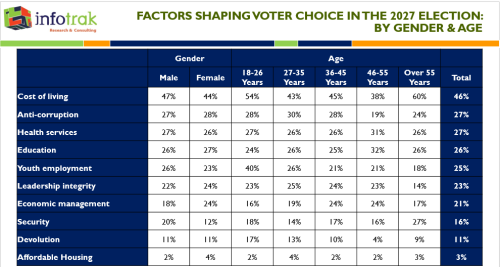
The rising cost of living has emerged as the most influential factor shaping voter choice ahead of Kenya’s 2027 general election. According to a new Infotrak survey findings released on Sunday, December 28, 2025, the poll analyses voter priorities by gender and age.
The survey shows that 46 per cent of respondents consider the cost of living as the single most important issue that will determine how they vote, cutting across gender and age groups.
Men (47 per cent) and women (44 per cent) are almost equally concerned. Young voters aged 18–26 years show heightened sensitivity to the issue, with 54 per cent citing the cost of living as their top concern.
The figure rises sharply among voters aged over 55 years, where 60 per cent prioritise the issue, making it the most decisive factor for senior voters.
Corruption, health and education remain key
You Might Also Like



Anti-corruption and health services jointly rank as the second most influential factors, each cited by 27 per cent of respondents. Anti-corruption resonates most with voters aged 27–35 years at 30 per cent, while health services are particularly important to those aged 46–55 years, where concern peaks at 31 per cent.
Education closely follows at 26 per cent, with women (27 per cent) slightly more likely than men (26 per cent) to prioritise the sector. Voters aged 46–55 years show the strongest emphasis on education at 32 per cent.
Youth employment
Youth employment stands out as a defining issue for younger Kenyans. While it accounts for 25 per cent overall, a striking 40 per cent of voters aged 18–26 years say job creation for young people will influence their vote, reflecting high unemployment and economic uncertainty among the youth.
Leadership integrity and economic management
Leadership integrity (23 per cent) and economic management (21 per cent) also feature prominently. Women are more likely to prioritise economic management (24 per cent) compared to men (18 per cent).
Security, devolution and housing lag behind

Security concerns rank at 16 per cent, with older voters over 55 years showing the greatest concern at 27 per cent. Devolution influences 11 per cent of voters, gaining more traction among the youth than older age groups. Affordable housing ranks lowest at just 3 per cent, indicating that while housing remains a national conversation, it is not yet a decisive voting issue for most Kenyans.
As the election approaches, the Infotrak poll suggests that Kenyans are less driven by rhetoric and more focused on practical solutions that directly impact their daily lives.
Author
Latest News








Advertisement
More on News