What every parent should know about measles right now
By Faith Lagat, November 30, 2025Measles is back in the headlines, and it’s not just a mild childhood illness.
The World Health Organisation (WHO) is sounding the alarm: this highly contagious airborne virus can kill, and it’s spreading again in places where it was once nearly wiped out.
In 2024 alone, an estimated 95,000 people, mostly unvaccinated children under five, died from measles worldwide, even though a safe, cheap vaccine exists. For today’s parents, the resurgence is a sharp reminder that vigilance is still necessary.
Classic signs you can’t miss
The rash is what everyone remembers, but it’s rarely the first clue. According to WHO, measles typically starts 10–14 days after exposure with a cluster of symptoms that can easily be mistaken for a bad flu.
High fever, cough, runny nose, and red, watery eyes often appear first. Tiny white spots with bluish-white centres inside the mouth on the inner cheeks, known as Koplik spots, are a major red flag.
A few days later, a red, blotchy rash breaks out on the face and upper neck before spreading downward to the torso, legs, hands, and feet over three days. The rash usually lasts about a week.
If your child shows these symptoms, especially the combination of fever, cough, red eyes, and a spreading rash, it’s crucial to seek medical care the same day.
Measles spreads through the air when an infected person coughs or sneezes and can remain in the air for up to two hours. One infected child can infect up to 18 others, making it one of the most contagious diseases on the planet.
Why is it so dangerous?
Measles isn’t “just a rash”. It attacks the respiratory system first before spreading throughout the body. Serious complications are common and can be life-threatening.
Pneumonia is the leading cause of measles-related deaths in children. Encephalitis, or brain swelling, can cause permanent damage. Severe diarrhoea leads to dehydration, while ear infections may result in hearing loss. In some cases, measles can cause blindness.
The highest risks fall on children under five, malnourished children, and those with weakened immune systems. Even more worrying, measles wipes out immune memory, leaving children vulnerable to other infections for years afterwards. Pregnant women who contract measles face severe risks, including miscarriage, premature birth, or low-birth-weight infants.
Before the measles vaccine was introduced in 1963, major epidemics killed an estimated 2.6 million people every year. Because of widespread vaccination, deaths dropped by 88% between 2000 and 2024, saving 59 million lives.
Yet in 2024, global first-dose coverage fell to 84%, and only 76% of children received the crucial second dose. Even these small declines are enough to trigger outbreaks.
Real-world warning signs
Countries across the world are now racing to close the immunity gap. In Kenya, Health Cabinet Secretary Aden Duale launched a nationwide measles-rubella vaccination campaign in July 2025 after nearly 3,000 measles cases and 18 deaths were recorded in just over a year.
The campaign targeted every child aged 9–59 months with an additional dose and introduced a new single-shot typhoid vaccine for children up to 14 years. The message from the Ministry of Health was unmistakable: missed vaccinations during the pandemic years and low second-dose uptake created dangerous gaps.
Similar catch-up efforts are happening worldwide. Health leaders understand the math: if vaccination rates fall even slightly, measles returns with force.
Two doses of the measles-containing vaccine (MMR or MR) provide 97% protection. The vaccine is safe, affordable, and widely available; in many countries, the cost is less than one dollar per child. If your child missed a dose or you’re unsure of their vaccine status, it’s never too late. Clinics, paediatricians, and nationwide campaigns offer free or low-cost catch-up vaccinations.
Health Cabinet Secretary Aden Duale raised particular concern about rising measles transmission, noting that the disease remains one of the most contagious viral infections globally and spreads quickly in areas with low vaccination coverage.
He emphasised that even a single case can trigger an outbreak in densely populated communities, making timely immunisation essential.
According to the Ministry of Health, gaps in the uptake of the second measles-rubella dose have left many children vulnerable, contributing to periodic flare-ups and preventable hospitalisations across several counties.
Bottom line for parents
Measles is one of the most contagious and dangerous childhood diseases. It can kill, cause lifelong disability, and leave children vulnerable to infections for years after recovery. The best protection is simple: vaccination.
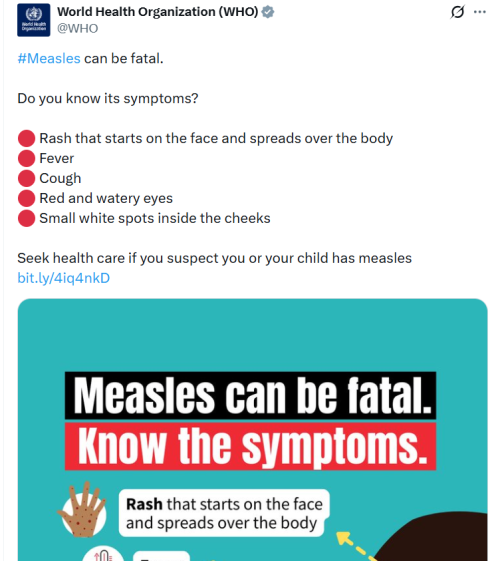
“Measles can be fatal. Do you know its symptoms? A rash that starts on the face and spreads over the body. “Fever, cough, red and watery eyes, small white spots inside the cheeks,” an X post from WHO read.
Know the early signs: check your child’s vaccination record today.
- Rash that starts on the face and spreads over the body
- Fever
- Cough
- Red and watery eyes
- Small white spots inside the cheeks
As WHO repeatedly warns, measles anywhere is a threat everywhere. Protecting children through complete vaccination remains one of the smartest, simplest acts of love and responsibility for families and communities alike.