Advertisement
Kenya’s alcohol crisis: Schools as battlegrounds, parents as key players
Sunday 24th August, 2025 07:10 AM|

Kenya is staring down an escalating alcohol crisis that threatens to rob its youth of their potential, and schools have emerged as the frontline in this fight.
On August 22, 2025, the National Authority for the Campaign Against Alcohol and Drug Abuse (NACADA) unveiled an ambitious policy aimed at curbing substance abuse in educational institutions.
The policy seeks to make schools safe havens for children, placing more emphasis on prevention rather than punishment.
But while classrooms are critical battlegrounds, the long-term solution may lie elsewhere. Parents, as the first line of defence, hold the most powerful influence over the choices their children make. Without their active involvement, even the most aggressive government-led policies will fall short.
Alarming statistics
You Might Also Like



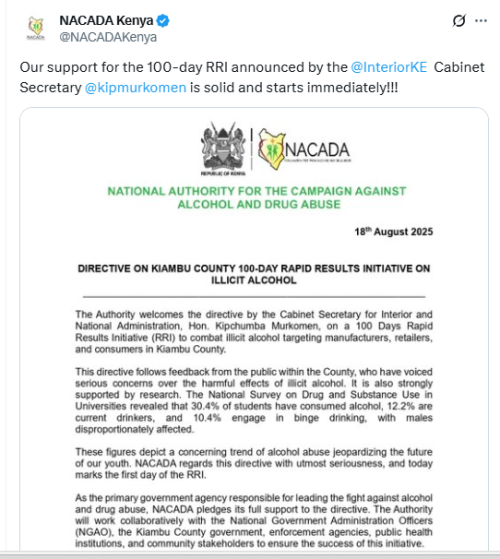
NACADA’s latest policy comes against the backdrop of grim findings from the National Survey on Drug and Substance Use in Universities released on August 18, 2025.
According to the report, 30.4 percent of university students have consumed alcohol, 12.2 percent are current drinkers, and 10.4 percent binge drink. Male students are disproportionately affected, painting a worrying picture of a generation veering dangerously close to addiction.
NACADA has warned that the figures represent more than statistics—they point to a national crisis that could cripple Kenya’s workforce and societal fabric in years to come.
The school-focused initiative dovetails with Interior Cabinet Secretary Kipchumba Murkomen’s 100-day Rapid Results Initiative targeting illicit brews, particularly in Kiambu County, a known hotspot.
On August 18, Murkomen launched the crackdown with support from NACADA, law enforcement, and local leaders. The effort is a response to growing public outrage over adulterated brews that have claimed dozens of lives. NACADA has pledged to reinforce the initiative with education campaigns, stricter monitoring, and sustained collaboration with counties.
Yet the agency’s broader strategy has triggered fierce debate. Its July 30 proposal to raise the drinking age to 21, ban supermarket and restaurant alcohol sales, block online deliveries, and prohibit celebrity endorsements has been met with sharp criticism.
Industry players argue the restrictions are not only impractical but also risk pushing consumers into the very illicit market NACADA wants to eliminate. Lawyer Donald Kipkorir described the proposals as “a recipe for economic disaster”, while the Alcoholic Beverage Association of Kenya slammed the agency for sidelining stakeholders in crafting policy.
Global lessons, local realities
Kenya is not alone in grappling with alcohol abuse, but NACADA’s proposed approach is among the harshest worldwide. In the United States, the drinking age is 21, yet alcohol remains accessible in supermarkets and restaurants.
Germany allows limited consumption as early as 14 under supervision, while Nordic countries regulate alcohol tightly but still maintain broader access than Kenya’s proposed bans. Only religiously conservative nations such as Saudi Arabia and Iran enforce restrictions as severe as those on NACADA’s drawing board.
This raises a critical question: can prohibitionist measures succeed in a country with Kenya’s vibrant digital commerce and enforcement challenges? Critics warn that the restrictions could simply criminalise ordinary behaviour without addressing root causes.
Kenya’s own history offers a cautionary tale. In 2024, NACADA seized 2.8 million litres of illicit alcohol and made 30,000 arrests, yet drug-related court cases surged 44 per cent between 2016 and 2018. Substance abuse levels remain stubbornly high, suggesting that enforcement alone cannot solve the crisis. Similarly, former Deputy President Rigathi Gachagua’s proposal to limit towns to a single pub collapsed under economic and social realities.
Global models show there are smarter alternatives. Portugal’s bold decision to decriminalise drugs while investing heavily in treatment drastically reduced drug-related deaths. In the Nordic countries, a balance between regulated access, strong welfare systems, and early intervention has helped keep substance abuse under control.
Kenya can borrow lessons from these models—expanding school-based prevention programmes, investing in treatment facilities, and tackling socioeconomic triggers such as poverty and peer pressure.
First line of defense
While schools and government crackdowns matter, NACADA itself has acknowledged that the home is the real starting point. On August 20, the agency posted on X: “Parents: Your home is the first classroom. You are the most important teacher.”
This reminder could not be more timely. Research shows that three in ten Kenyan learners experiment with alcohol before they turn 18. The guidance—or neglect—of parents plays a decisive role in whether curiosity turns into a destructive habit.
Parents must therefore go beyond mere warnings. They must model responsible behaviour, set clear boundaries, and foster open conversations about alcohol. In many cases, youth turn to substances not simply out of rebellion, but as an escape from poverty, peer pressure, or lack of recreation. Parents, together with schools and communities, are uniquely positioned to confront these influences early.
The stakes could not be higher. With an estimated 4.73 million Kenyans already using substances and children as young as six experimenting with tobacco, Kenya risks nurturing a lost generation.
Schools may serve as battlegrounds for prevention, but parents remain the generals of this war. Their active engagement, coupled with pragmatic, evidence-based policies, is what will determine whether NACADA’s ambitious initiatives succeed or falter.
The lesson is clear: punitive crackdowns and sweeping bans, while politically attractive, cannot substitute for thoughtful, community-driven solutions. Kenya’s youth need protection, guidance, and opportunities—not just punishment. Parents must lead this fight at home, while NACADA shifts from moral panic to policies that empower families and communities.
Only then can Kenya hope to tame its alcohol crisis and secure the future of its next generation.
Author
Latest News





Advertisement
More on Insights