Advertisement
International Missing Children’s Day 2026: Kenya faces growing crisis of missing minors
Thursday 14th May, 2026 08:28 AM|

International Missing Children’s Day is coming, and as Kenya is set to celebrate on 25th May 2026, there is growing worry about the number of children going missing, and some of the recent ones have raised cries of outrage in the country and high-level discussions on social media platforms.
Celebrated every 25th May globally, the day aims to raise awareness of missing children, provide assistance to affected families and reinforce systems in place to keep children safe from abuse, trafficking, abduction and exploitation.
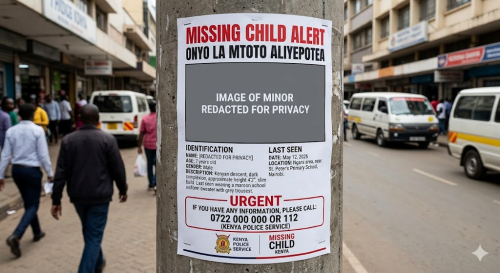
The commemoration in Kenya this year is happening amid the shocking social media posts of missing children, which are even being posted on police stations and government platforms.
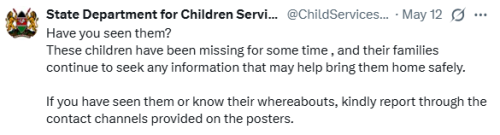
The State Department for Children Services renewed public interest in the children’s issue on May 12, giving out posters of several missing children with no explanation as to where they were.
You Might Also Like



“Have you seen them? These children have been missing for some time, and their families continue to seek any information that may help bring them home safely. If you have seen them or know their whereabouts, kindly report through the contact channels provided on the posters,” the department noted in a statement.
Viral incidences
One of the cases that made headlines was that of the disappearance of 16-year-old Kenya High School student Joy Wanjiru Gathigia. The teenager disappeared for over five weeks after leaving school for the April holidays, sparking an intense search across the country, aided by her family and social media mobilisation.
Her disappearance was the topic of discussion on social media, with Kenyans sharing her photos and CCTV images of her activities before her disappearance. The emotional aspect of the case took another twist when the last hope, Joy, was found alive after weeks of uncertainty in Thika, followed by viral videos of her reuniting with her mother.
The other disturbing case that shocked Kenyans was that of Brighton Kibet, who was kidnapped and murdered in the West Pokot region, shocking the entire country. The incident was connected to a suspected criminal network of ritual killings and organ harvesting. The violent aspects of the case led to widespread public anger and renewed concerns about the trafficking of children and ritual offences against minors.
The death of nine-year-old Shantel Waruguru Kagema in Nyeri County also rocked the nation. The child had left her house before her discovery by detectives in a pit latrine. The boy’s death sparked renewed calls for child safety and child vulnerability in the communities, with a suspect arrested for the crime.
One of the incidents that gained much publicity was the disappearance and subsequent dramatic rescue of a 3-year-old child from Malindi before he crossed the Kenya-Tanzania border.
The authorities suspected an attempted trafficking incident, and police succeeded in stopping the boy from being smuggled out of the country. The rescue was met with great joy online but also revealed a growing sophistication in the networks that target children for trafficking.
Child protection agencies say thousands of children are reported missing in Kenya each year, and few of these cases are ever solved, and some remain unresolved for months or years. While most reported disappearances are of teenagers aged 13-17, younger children are becoming the victims, too.
Underreporting, a family’s failure to report, and less-than-optimal coordination between law enforcement and child protection institutions make the actual crisis possibly much worse.
Why are children missing?
Child protection experts believe that some of the major reasons for the rise in disappearances are human trafficking, domestic violence/grooming, online grooming, family disputes, child labour, poverty, neglect and exploitation.
Some run away from home from family situations where there is abuse, and others are enticed by online predators who pretend to be friends or benefactors. Authorities have also voiced concerns about domestic trafficking rings for children from poor or disadvantaged families and have stated that these children are being trafficked across borders.
Weak security systems, poverty and lack of access to child protection services are some of the factors that place urban informal settlements and remote rural areas among the most vulnerable regions.
Government’s responses to the crisis
The Kenyan government, through the Directorate of Children Services, the Directorate of Criminal Investigations (DCI) and other child welfare organisations, has stepped up in terms of awareness campaigns and emergency responses to help trace children.
Police, local administrators and children’s offices, as well as Child Helpline 116, are all groups that are still encouraged by authorities to report disappearances at once.
The government has also been increasingly using digital platforms as a way of disseminating alerts on missing children, seeking to enhance response time and public involvement in missing child tracing.
With Kenya joining the world in celebrating International Missing Children’s Day 2026, families of missing children remain in a state of perpetual pain as they hold onto hope that their loved ones will return home safe and sound.
Author
Latest News







Advertisement
More on Insights