How to transfer vehicles under succession cases
By Aloys Michael, January 20, 2026The National Transport and Safety Authority (NTSA) has published new guidelines detailing how vehicles inherited through succession should be transferred to beneficiaries.
The process aims to ensure lawful ownership changes and smooth estate management.
According to NTSA, the succession transfer procedure is designed to protect families, secure estates, and prevent disputes over motor vehicle ownership. The authority emphasised that compliance is necessary to avoid legal conflicts.
The guidelines state that vehicles registered under deceased owners can only be transferred through an alternative or forced transfer process. This applies where the original owner is unavailable to complete the transaction.
NTSA noted that the legally mandated process helps administrators settle estates without conflict. It ensures all vehicle transfers follow proper legal and regulatory frameworks.
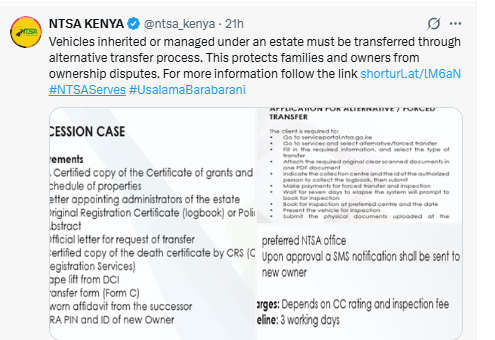
“Vehicles inherited or managed under an estate must be transferred through an alternative transfer process. This protects families and owners from ownership disputes,” the authority wrote on X.
The succession process begins with documentation, and the authority requires a certified copy of the Certificate of Grants and the schedule of properties.
Families must also present a letter appointing the administrators of the estate, as this confirms the individuals legally allowed to manage the property.
NTSA said the original registration certificate, which is commonly known as the logbook, must be produced, and if the logbook is missing, a police abstract can be used.

An official letter requesting the transfer is required as well. In addition, the applicant must provide a certified copy of the death certificate issued by the Civil Registration Services,” NTSA noted.
The agency also demanded a tape lift report from the Directorate of Criminal Investigations.
A transfer form, known as Form C, must be filled and families must also provide an affidavit from the successor.
The final requirement is the KRA PIN and identification documents of the new owner.

NTSA said the documents are mandatory to ensure a clear and uncontested transition of ownership.
Once the family gathers the documents, the alternative or forced transfer application begins.
The applicant is required to access the NTSA service portal at serviceportal.
“Select the alternative or forced transfer option, then fill in the required information. The applicant is also required to choose the correct transfer type,” the authority clarified.
NTSA directed applicants to attach clear scanned copies of all the required documents in one PDF file.
The client must then indicate the collection centre and provide the identification details of the authorised person who will collect the logbook.

The guidelines
After this step, the application is submitted through the portal.
Payment is, however, required for forced transfer and inspection, and the amount depends on the vehicle’s engine capacity and the inspection fee.
NTSA said these charges vary because of the rating of different units, and after payment, the applicant must wait for seven days.
NTSA further noted that the system automatically prompts the client to book for inspection once the seven-day period has elapsed.
“The inspection must be booked at a preferred centre and for a specific date. On the inspection day, the vehicle must be presented physically. The applicant must also submit original copies of the documents that were uploaded online,” they said.

NTSA noted that this physical verification is critical for confirming the vehicle details and ensuring the transfer is legitimate.
The authority said that once the inspection and document submission are complete, the applicant should wait for approval.
Upon approval, NTSA will issue a notification. The agency states that “Upon approval, an SMS notification shall be sent to the new owner.”
This message informs the applicant that the transfer has been processed.
Consequently, the timeline for completing the process is three working days, which covers the administrative handling of the transfer after the inspection is done.