Advertisement
Willis Otieno warns democracy is decaying due to tribal political defense
Sunday 17th May, 2026 05:37 PM|

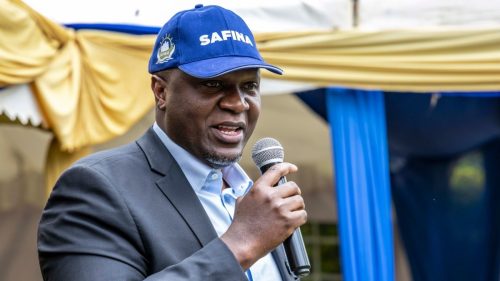
Lawyer and political commentator Willis Otieno has issued a strong warning over what he describes as the growing danger of tribal-based political loyalty in Kenya, saying it is weakening accountability and undermining democratic governance.
Taking to his official X account on Sunday, May 17, 2026, Otieno argued that many Kenyans have abandoned critical thinking in favour of defending leaders purely on ethnic grounds, a trend he said is distorting public debate and shielding leaders from scrutiny.
Otieno criticised what he termed the normalisation of tribal loyalty in politics, saying it has led to a culture where leaders are defended not based on performance but on shared identity.
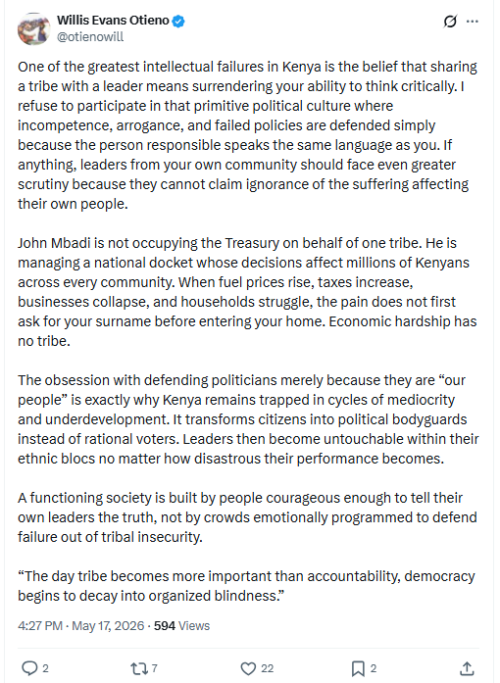
“One of the greatest intellectual failures in Kenya is the belief that sharing a tribe with a leader means surrendering your ability to think critically,” Otieno stated.
You Might Also Like


He warned that such thinking encourages citizens to ignore poor governance as long as the leader belongs to their community.
Call for accountability over identity
The Safina deputy party leader emphasised that public office is national in nature, and leaders must be judged on their performance rather than ethnic affiliation.
He singled out the Treasury docket, currently held by John Mbadi, noting that economic decisions affect all Kenyans equally, regardless of background.
“I refuse to participate in that primitive political culture where incompetence, arrogance, and failed policies are defended simply because the person responsible speaks the same language as you. If anything, leaders from your own community should face even greater scrutiny because they cannot claim ignorance of the suffering affecting their own people,” he stated.
“John Mbadi is not occupying the Treasury on behalf of one tribe. He is managing a national docket whose decisions affect millions of Kenyans across every community. When fuel prices rise, taxes increase, businesses collapse, and households struggle, the pain does not first ask for your surname before entering your home. Economic hardship has no tribe.”
Otieno added that economic hardship transcends ethnic boundaries and should therefore be addressed through accountability rather than political loyalty.
Warning against tribal political culture
He further warned that the habit of defending leaders based on tribal identity has created a system where incompetence and poor governance go unchallenged.
“The obsession with defending politicians merely because they are ‘our people’ is exactly why Kenya remains trapped in cycles of mediocrity and underdevelopment,” he said.
According to Otieno, this dynamic transforms citizens into “political bodyguards” rather than informed voters capable of demanding better leadership.
The lawyer also warned that democracy risks weakening further if citizens continue prioritising ethnic loyalty over accountability.
“A functioning society is built by people courageous enough to tell their own leaders the truth,” he said.
“The day tribe becomes more important than accountability, democracy begins to decay into organised blindness.”
His remarks come amid ongoing national debate over governance, economic pressure, and the role of ethnic politics in shaping leadership choices ahead of the 2027 General Election.
There has been an increasing frustration among some commentators who are calling for issue-based politics as Kenya navigates rising living costs and heightened political competition.
Author
Mustafa Juma
View all posts by Mustafa JumaLatest News



Advertisement
More on Inside Politics