Advertisement
Willis Otieno calls for political ceasefire as 2027 election tensions rise
Thursday 02nd July, 2026 09:43 AM|

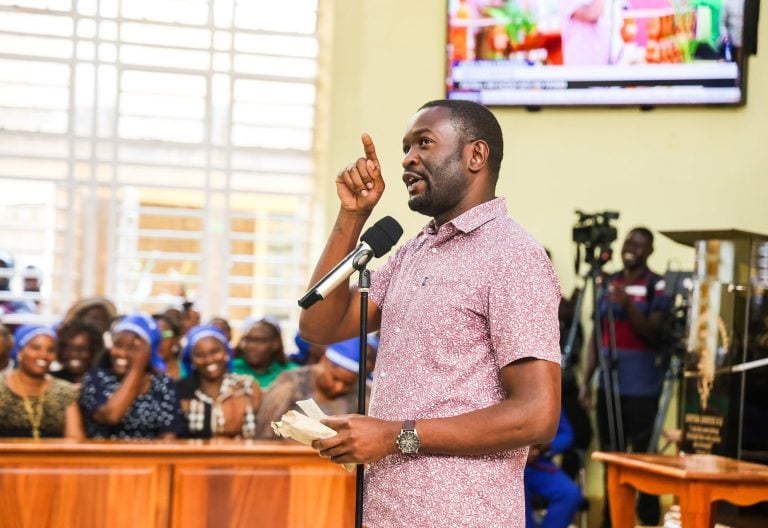
Safina deputy party leader, Willis Otieno, has asked politicians to avoid hate speech, intimidation and violent political mobilisation as Kenya moves closer to the 2027 General Election.
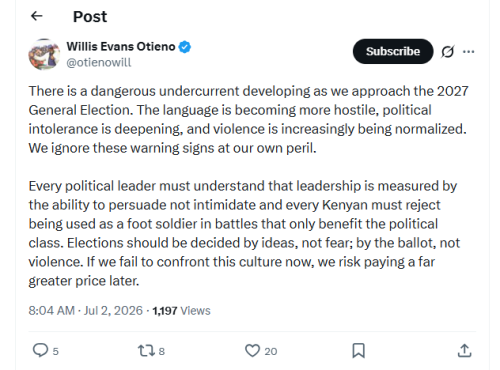
Otieno, in a statement posted on X on Thursday, July 2, 2026, warned that the country is entering a dangerous political season where hostile language, intolerance and violence are slowly being normalised.
Otieno sends a warning
“There is a dangerous undercurrent developing as we approach the 2027 general election.

“The language is becoming more hostile, political intolerance is deepening, and violence is increasingly being normalised. We ignore these warning signs at our own peril,” Otieno said.
You Might Also Like



His remarks come at a time when political camps are already drawing battle lines ahead of the next presidential contest, with President William Ruto expected to defend his seat while opposition figures and other aspirants position themselves for the race.
2027 numbers
The warning by Otieno goes to the heart of Kenya’s electoral reality.
In 2022, the presidency was decided by numbers. Ruto won with 7,176,141 votes against Raila Odinga’s 6,942,930 votes, a difference of 233,211 votes.
That margin remains politically important because it shows how narrow presidential contests can be in Kenya.
With more than 22 million registered voters in 2022, any serious politician eyeing 2027 should be speaking to voters, not mobilising fear.
The next president will be made by turnout, persuasion, coalitions, regional arithmetic and credibility before the electorate.
That is the point Otieno appears to be making.
Political ceasefire
Otieno said leaders must understand that democratic leadership is tested through persuasion, not intimidation.
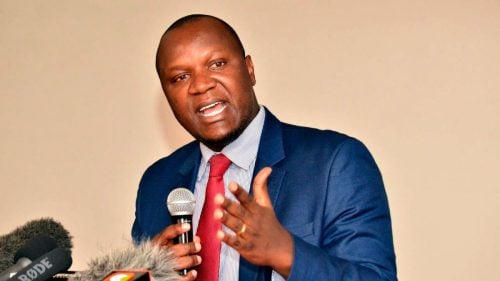
“Every political leader must understand that leadership is measured by the ability to persuade, not intimidate, and every Kenyan must reject being used as a foot soldier in battles that only benefit the political class,” he said.
The statement is politically loaded because Kenya is already witnessing rising tension around rallies, by-elections, protest politics, party defections and early 2027 alignments.
Those lining up for the presidency, whether from government, opposition, or independent political formations, are not fighting for empty ground.
They are fighting for the same voters who must be protected from violence, propaganda, and ethnic incitement.
Otieno warned that Kenyans should not allow themselves to be reduced to political weapons for leaders who retreat to comfort once elections are over.
“Elections should be decided by ideas, not fear; by the ballot, not violence. If we fail to confront this culture now, we risk paying a far greater price later,” he added.
IEBC warning
The Independent Electoral and Boundaries Commission, working alongside the National Cohesion and Integration Commission, is expected to take a harder line on hate speech, tribal balkanisation and inciting political language ahead of the next polls.
The IEBC enforces the Electoral Code of Conduct, which bars candidates and political parties from language or conduct that promotes violence, hatred, intimidation or discrimination.
Politicians who breach the code can be summoned before disciplinary organs and may face sanctions, including possible disqualification from contesting elections.
The NCIC, on the other hand, has the mandate to monitor hate speech and divisive rhetoric, including statements made at rallies, in the media and on digital platforms.
This means the 2027 contest will not only be fought in rallies and polling stations. It will also be fought under the scrutiny of institutions watching how leaders speak, mobilise and behave.
Ballot politics
Otieno’s warning lands at a moment when Kenya’s political class is already behaving as if the campaign season has formally opened.
The risk is that hostile language used today can become violence tomorrow.
Kenya has walked that road before, and the cost has always been paid by ordinary citizens, not the politicians who incite them.
Author
Latest News







Advertisement
More on Inside Politics