Advertisement
Senator Hezena: Corruption starts with voters, not Parliament
Friday 03rd July, 2026 12:08 AM|

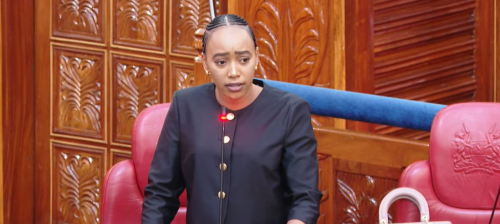
Nominated Senator Hezena Lemaletian has said Kenya’s corruption crisis begins with voters rather than Parliament, arguing that elected leaders are a reflection of the society that chooses them and that the fight against graft must start with individual citizens.
Speaking during a July 1, 2026, interview, the Samburu senator said both the National Assembly and the Senate mirror the Kenyan population, meaning the country’s social challenges inevitably find their way into leadership. She maintained that corruption should be treated as a collective responsibility instead of placing blame solely on politicians.
“Parliament is a perfect representation. Both houses are a perfect representation, a representative sample of the Kenyan population. If there is a murder out there, you can be sure they have their representative. If there’s a thief out there, you can be sure they have their representative. If there’s a corrupt person, you can be sure there is a good representative within,” she said.
According to Hezena, many politicians secure elective office by bribing voters and offering inducements instead of earning genuine public support, creating a cycle where leaders feel less accountable after elections.
Vote buying entrenches corruption
You Might Also Like

The senator said the culture of political handouts has made elections increasingly expensive, with candidates feeling compelled to distribute money and other incentives to attract supporters.
She claimed some politicians buy alcohol for young people to mobilise crowds, attack opponents or influence political activities, adding that she has deliberately avoided such tactics despite the pressure to do so.
Hezena also reflected on an experience from her student days while seeking bursary support in Samburu. She recalled that an MP told university students waiting outside his office that he owed them nothing because he had already “bought” their parents’ votes during elections.
She said such experiences illustrate how vote buying weakens accountability and encourages leaders to view public office as an investment to be recovered rather than a responsibility to serve citizens.
The senator further argued that corruption has spread beyond politics into public institutions, where money is increasingly used to influence decisions, evade justice and manipulate accountability processes.
She also claimed that some opinion polls are influenced by payments from politicians seeking favourable rankings, saying such practices distort public perception and reward those with financial muscle rather than performance.
National concern over corruption
Hezena’s remarks come as concerns over corruption continue to dominate public discourse.
On June 16, former Chief Justice David Maraga said Kenya loses an estimated Ksh3 billion every day to corruption, warning that the continued misuse of public resources is worsening the country’s debt burden and limiting funding for essential services.
His remarks came days after Treasury Cabinet Secretary John Mbadi presented the 2026/27 Budget of Ksh4.78 trillion. By March 2026, Kenya’s public debt had risen to Ksh12.82 trillion, prompting renewed calls from governance advocates for a forensic audit of government borrowing and expenditure.
The anti-corruption debate was further amplified on June 4 after the Ethics and Anti-Corruption Commission (EACC) raided the Nairobi home of suspended Chief Officer for Urban Development Patrick Analo Akivaga and recovered Ksh65.3 million in cash alongside documents linked to ongoing investigations.
Following the operation, the National Integrity Alliance welcomed the recovery but called for speedy prosecution, asset recovery under the Proceeds of Crime and Anti-Money Laundering Act, lifestyle audits and stricter enforcement of the Conflict of Interest Act, 2025. The alliance also warned that procurement fraud, embezzlement and weak oversight continue to undermine service delivery, particularly in county governments.
Responsibility starts with citizens
The Samburu senator said corruption has evolved beyond conventional bribery, describing newer forms of inducement, including what politicians commonly refer to as “form”—small payments given to young people to mobilise support, attack opponents or promote political interests.
She maintained that lasting reforms would only be achieved when citizens reject bribery and embrace personal responsibility.
“And the day we stop corruption in this country is the day we put the record straight in this country and we straighten everything. And it has to start from individuals. The day you start being patriotic and say, this country is my responsibility. Let me not bribe. Let me not throw garbage. Let me be responsible from within. Then we are able to change this country,” she said.
Hezena said Kenya’s fight against corruption will only succeed when voters reject transactional politics and demand accountability from those seeking public office, arguing that Parliament will continue to reflect the choices made by the electorate.
Author
Latest News





Advertisement
More on Inside Politics