Willis Otieno slams State House for overspending while Kenyans struggle
By Kenneth Mwenda, February 17, 2026Willis Evans Otieno, the Deputy President Designate for the Safina Party, has sharply criticised State House over what he calls excessive spending in the 2025/26 financial year.
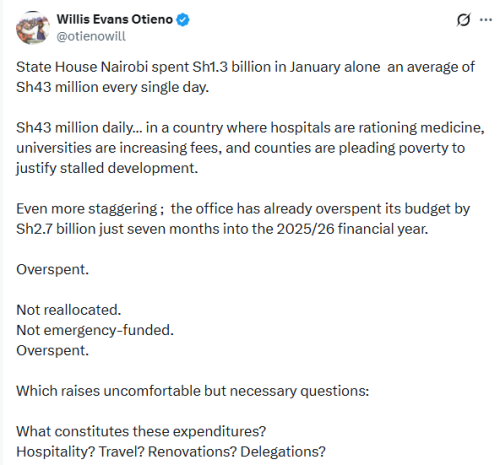
In a widely shared post on X on February 17, 2026, Otieno said State House Nairobi spent Ksh1.3 billion in January alone. That works out at an average of Ksh43 million every day.
He described the figure as shocking at a time when many Kenyans face economic strain.
“State House Nairobi spent Sh1.3 billion in January alone an average of Sh43 million every single day. Sh43 million daily… in a country where hospitals are rationing medicine, universities are increasing fees, and counties are pleading poverty to justify stalled development,” Otieno wrote.
Treasury data supports part of his claim. By the end of January 2026, State House’s recurrent expenditure had reached Ksh10.4 billion. The approved allocation for the full financial year stood at Ksh7.7 billion. This means the office exceeded its annual budget by Ksh2.7 billion with five months still remaining in the fiscal year.
That spending rose sharply in January, with daily averages of more than Ksh42 million.
Otieno stressed that the overspending was not the result of a formal reallocation or emergency funding.
“Even more staggering; the office has already overspent its budget by Ksh2.7 billion just seven months into the 2025/26 financial year. Overspent. Not reallocated. Not emergency-funded. Overspent,” he said.
He also questioned what drove the high costs.
“Which raises uncomfortable but necessary questions: What constitutes these expenditures? Hospitality? Travel? Renovations? Delegations? How do daily operational costs reach tens of millions while citizens are being told to tighten belts?”
Recurrent expenditure covers travel, accommodation, allowances, hospitality and administrative costs. These expenses keep State House running as the centre of executive activity. Costs can increase during periods of heavy travel and public events, but the current figures stand out.
Otieno accused the government of applying austerity selectively.
“Because austerity, it seems, is being preached downward not practiced upward. Kenyans are being taxed more, charged more, and squeezed more… while the seat of executive power expands its consumption beyond approved limits,” he wrote.
The Office of the Deputy President also exceeded its recurrent budget by Ksh361.6 million. According to Treasury records, these two offices are the only ones to breach their full-year allocations this early in the financial year.
Supplementary budget raises deficit
The Treasury has warned that early exhaustion of budgets complicates planning. It can force unplanned reallocations and increase pressure on public finances.
The government is now preparing a Ksh262.9 billion supplementary budget. The proposal would push total spending for the year ending June 2026 to Ksh4.532 trillion, up from Ksh4.269 trillion. Recurrent expenditure would rise by Ksh204.6 billion to Ksh3.338 trillion, while development spending would increase by Ksh58.3 billion to Ksh707.3 billion.

At the same time, the fiscal deficit would grow from Ksh901 billion to Ksh1.14 trillion, about six per cent of GDP.
Otieno linked the spending to wider public frustration.
“That contradiction is what fuels public anger. You cannot run a high-spending presidency in a low-surviving economy. Because when the nerve centre of government becomes the epicentre of excess… the message to the nation is simple: Sacrifice is for citizens, not leadership,” he said.
His remarks reflect concerns many Kenyans have raised about rising taxes and shrinking public services. Hospitals report drug shortages. Universities have increased fees. Several counties say they lack funds to complete projects.
Earlier in the financial year, State House sought additional funding more than once. In September 2025, it requested Ksh2 billion for other operating expenses. Another Ksh2 billion followed. The Treasury approved Ksh4 billion in extra financing.
Controller of Budget Margaret Nyakang’o has previously warned about rapid spending rates and the risk of mid-year depletion. She also flagged delays in major State House projects, which could lead to higher costs.
President William Ruto’s administration has pledged austerity to reduce borrowing and manage the wage bill. However, the latest figures have renewed debate about fiscal discipline at the top of government.