TIFA poll reveals counties and regions that could decide the 2027 election
By Mustafa Juma, July 24, 2026Kenya’s 2027 presidential election may ultimately be won or lost not in the traditional political strongholds of the Rift Valley, Nyanza or Mt Kenya alone, but in a handful of competitive regions where millions of undecided and swing voters could tip the balance.
That is one of the clearest takeaways from the latest Trends and Insights for Africa (TIFA) national opinion survey released on Friday, July 24, 2026, which paints a picture of an increasingly fragmented political landscape with no single candidate enjoying overwhelming nationwide dominance.
While President William Ruto and the opposition continue to command loyal support in their respective bases, the poll suggests that several vote-rich regions have become highly competitive, setting the stage for what could be Kenya’s most unpredictable election in decades.
Mt Kenya remains the biggest prize
The survey indicates that Mt Kenya, home to about 5.7 million registered voters, is shaping up as the country’s most fiercely contested political battlefield.
Unlike previous elections where one political camp largely dominated the region, the poll shows support split among several leading opposition figures, while President Ruto also retains a notable presence.
According to the survey, 25 per cent of respondents in Mt Kenya remain undecided, the highest among the country’s major voting blocs.
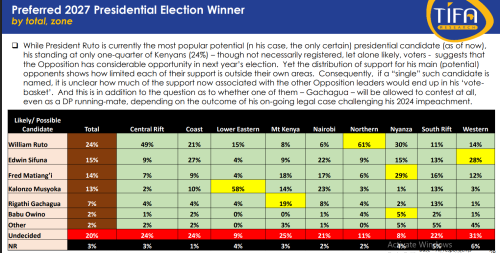
Among those who expressed a preference, Rigathi Gachagua leads with 19 per cent, closely followed by Fred Matiang’i at 18 per cent. Kalonzo Musyoka polls 14 per cent, while Edwin Sifuna records 9 per cent. President William Ruto attracts 8 per cent support in the region.
Political analysts say the large undecided vote means Mt Kenya remains very much in play despite the region having overwhelmingly backed Kenya Kwanza in 2022.
Nairobi could once again decide the presidency
Kenya’s capital also emerges as a crucial battleground.
With approximately 2.8 million registered voters, Nairobi has historically mirrored national political trends and often produces closely contested presidential results.
The latest TIFA survey reflects that competitiveness.
Among respondents, Kalonzo Musyoka leads with 23 per cent, narrowly ahead of Edwin Sifuna on 22 per cent, while Fred Matiang’i records 17 per cent.
President Ruto receives 6 per cent, Rigathi Gachagua 8 per cent, while 21 per cent remain undecided.
The findings suggest Nairobi could become one of the most heavily contested campaign theatres as parties compete for urban youth, professionals and first-time voters.
Coast remains up for grabs
The poll also identifies the Coast region as another electoral battleground.
Home to roughly 2.1 million registered voters, the region does not currently exhibit overwhelming support for any single political leader.
The survey places Edwin Sifuna at 27 per cent, followed by President Ruto at 21 per cent, Kalonzo Musyoka at 10 per cent, and Fred Matiang’i at 9 per cent.
Another 21 per cent of respondents remain undecided, highlighting the region’s importance heading into the 2027 campaigns.
Lower Eastern remains Kalonzo’s fortress
Although Lower Eastern is less competitive than some other regions, the survey confirms that Kalonzo Musyoka continues to dominate his traditional political base.
The Wiper leader enjoys 58 per cent support, compared to 15 per cent for President Ruto, while only 9 per cent remain undecided.
The findings reinforce Kalonzo’s continued influence in Ukambani and explain why he remains central to ongoing opposition coalition talks.
Western Kenya becoming increasingly competitive
Western Kenya also appears poised to play a decisive role.
The region, with more than 2.8 million registered voters, shows no overwhelming consensus behind a single presidential contender.
According to the poll, Edwin Sifuna leads with 28 per cent, followed by President Ruto at 14 per cent and Fred Matiang’i at 12 per cent.
Perhaps more importantly, 31 per cent of respondents remain undecided, the highest share outside Mt Kenya.
Political observers say whichever coalition successfully consolidates Western Kenya could gain a significant national advantage.
Strongholds still matter
While attention has shifted to swing regions, the survey confirms that traditional political bases remain largely intact.
President Ruto maintains overwhelming dominance in Northern Kenya, where he enjoys 61 per cent support, and remains strongest in parts of the Rift Valley.
Meanwhile, opposition support remains strong in Nyanza, although the survey points to an increasingly competitive environment there, with Fred Matiang’i polling 29 per cent and President Ruto recording 30 per cent, suggesting the political landscape is becoming more fluid than in previous elections.
Why the numbers matter
Kenya’s Constitution requires a presidential candidate to win more than 50 per cent of all valid votes cast and secure at least 25 per cent of votes in a majority of counties.
As a result, simply dominating one or two regions is rarely enough to secure victory.
Instead, candidates must build broad national coalitions capable of attracting support across diverse regions while limiting losses in their opponents’ strongholds.
The latest TIFA findings suggest that the next presidential race may ultimately hinge on persuading undecided voters in politically competitive regions such as Mt Kenya, Nairobi, Western Kenya and the Coast.
Campaign strategies likely to shift
The survey is expected to shape campaign strategies over the coming months.
Already, President Ruto has intensified development tours across politically strategic counties, while opposition leaders have increased joint engagements under the Linda Mwananchi and United Alternative Government banners.
With more than a year before Kenyans head to the ballot, the latest poll indicates that although political strongholds remain influential, the presidency may ultimately be decided in regions where millions of voters have yet to make up their minds.
For both Kenya Kwanza and the opposition, winning those battleground counties could prove decisive in determining who forms Kenya’s next government.