Advertisement
Viral cabinet nominees letter declared fake
Friday 24th July, 2026 03:14 PM|
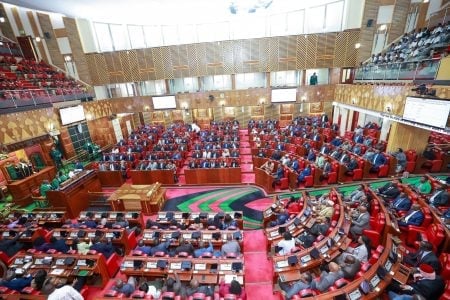
A letter circulating on social media claiming that the National Assembly had requested the Ethics and Anti-Corruption Commission (EACC) to vet five individuals for cabinet appointments has been declared fake by both Parliament and the anti-graft agency.
The document, dated July 23, 2026, appeared on National Assembly letterhead and was addressed to EACC Chief Executive Officer Abdi Ahmed Mohamud.
It purported to have originated from the Office of the Clerk of the National Assembly and requested integrity vetting of five purported Cabinet nominees before further parliamentary proceedings.
The letter listed Winnie Odinga for Tourism and Wildlife, Junet Mohamed for Lands, Public Works, Housing and Urban Development, Koki Muli for Water, Sanitation and Irrigation, Cleophas Malala for Agriculture and Livestock Development, and Agnes Zani for Information, Communications and the Digital Economy.
Parliament disowns document
You Might Also Like



In a clarification shared through its official communication channels, Parliament said the letter did not originate from the National Assembly and urged members of the public to disregard it.
“Stay informed with verified facts and avoid misinformation!” the Parliament Facebook post read.
The institution reminded Kenyans to verify information through official government communication platforms before sharing it.
The forged document claimed the National Assembly was acting in line with its constitutional mandate to ensure transparency and integrity in the appointment of senior public officials and requested that the EACC submit its findings by July 28, 2026.
It also carried the name of Samuel Njoroge as Clerk of the National Assembly and appeared to bear official contact details and branding associated with Parliament.
Parliament maintained that no such communication had been issued through its authorised channels.
EACC flags inconsistencies
The Ethics and Anti-Corruption Commission also dismissed the document, confirming it had not received any request from the National Assembly seeking vetting of Cabinet nominees.
The Commission shared a copy of the letter prominently marked “FAKE” and pointed to several inconsistencies, including grammatical errors, incomplete sentences and formatting that did not match official correspondence.
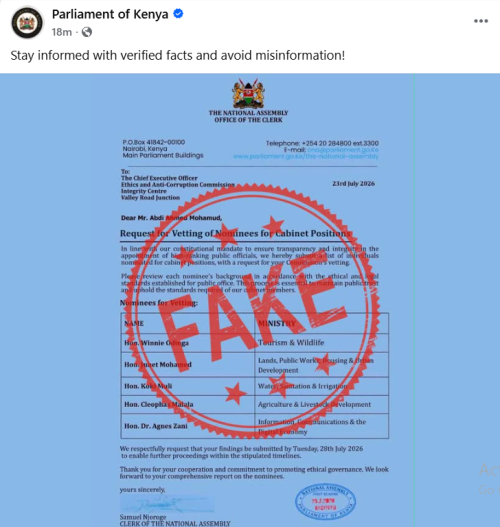
The clarification came as the document gained traction across social media platforms, where it was widely shared as speculation grew over possible changes in Cabinet.
No official communication from State House or the National Assembly has announced new cabinet nominations.
Speculation fuels circulation
The circulation of the forged letter coincided with increased political speculation surrounding a possible cabinet reshuffle ahead of the 2027 General Election.
Several of the names contained in the document belong to prominent political figures, prompting online discussion over possible changes within government.
Some social media users linked the claims to recent political developments, including the Ol Kalou parliamentary by-election held on July 16, where the Democracy for the Citizens Party won the seat.
Despite the speculation, there has been no official confirmation of cabinet nominations or changes from the Presidency or Parliament.
The incident adds to a growing list of fabricated government documents that have surfaced online in recent years, prompting repeated calls by public institutions for greater vigilance against misinformation.
Authorities have urged the public and media to verify documents through official channels before sharing them, saying accurate information is critical to maintaining public confidence in government institutions.
Author
Latest News





Advertisement
More on News