Advertisement
83% of Kenyans say they are registered voters as youth trail older voters – TIFA
Friday 24th July, 2026 03:55 PM|

More than four in five Kenyans say they are registered to vote ahead of the 2027 General Election, according to a new survey by Trends and Insights for Africa (TIFA) released on Friday.
The nationwide survey found that 83 per cent of respondents reported being registered voters. The findings are based on face-to-face interviews conducted with 2,048 randomly selected adults across all 47 counties between June 13 and June 22, 2026.
While the overall registration level is high, the survey points to significant differences across regions and age groups, particularly among younger Kenyans.
TIFA noted that self-reported registration figures should not be interpreted as a direct measure of future voter turnout, saying such responses do not always reflect actual participation on election day.
You Might Also Like



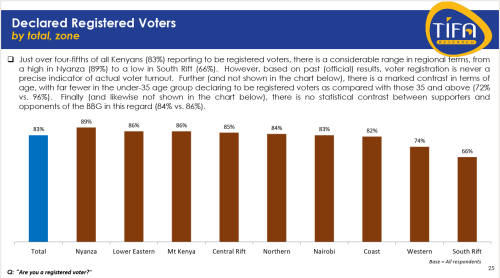
“Just over four-fifths of all Kenyans (83%) report to be registered voters; there is a considerable range in regional terms, from a high in Nyanza (89%) to a low in South Rift (66%),” the survey states.
Regional, age differences emerge
According to the survey, Nyanza recorded the highest proportion of self-reported registered voters at 89 per cent, followed by Lower Eastern and Mt Kenya at 86 per cent each and Central Rift at 85 per cent.
Northern Kenya and Nairobi recorded 84 per cent and 83 per cent respectively, while the Coast stood at 82 per cent. Western recorded 74 per cent, with South Rift posting the lowest level at 66 per cent.
The widest gap emerged across age groups.
Among respondents aged 35 years and above, 96 per cent said they were registered voters compared to 72 per cent of those below 35 years.
Registration was lowest among those aged between 18 and 24 years, highlighting a persistent challenge in bringing first-time voters into the electoral process.
Missing IDs top barriers
Among the 17 per cent of respondents who said they were not registered, the most common reason was the lack of a national identity card or other required registration documents.
Overall, 37 per cent cited missing identification documents, with the figure rising to 50 per cent among respondents aged between 18 and 24 years. Among those aged 45 years and above, only 11 per cent gave the same reason.
Lack of time and lack of interest in politics or voting each accounted for 22 per cent of responses among those not registered.
Others cited limited awareness of voter registration exercises, administrative challenges and the distance to registration centres.
TIFA said the findings suggest that access to identification documents remains one of the biggest barriers to expanding the voter register, particularly among young adults.
Political support shows little difference
The survey also found little difference in voter registration between supporters of the Broad-Based Government and its opponents.
According to the findings, 84 per cent of supporters of the Broad-Based Government said they were registered compared to 86 per cent of those opposed to the political arrangement.
The report noted that while public opinion remains divided on the cooperation between President William Ruto and Raila Odinga, those differences have not translated into significant variations in voter registration.
TIFA said 52 per cent of respondents opposed the Broad-Based Government arrangement, while 30 per cent supported it.
The survey also found that political competition ahead of the 2027 General Election remains fluid, with support spread across several candidates and a sizeable proportion of undecided voters.
TIFA concluded that the Independent Electoral and Boundaries Commission, together with the National Registration Bureau, faces the challenge of increasing youth voter registration before the next General Election, particularly by addressing barriers related to national identity documents.
The survey has a margin of error of plus or minus 2.18 percentage points and reflects public opinion at the time the fieldwork was conducted.
Author
Latest News






Advertisement
More on Inside Politics