Advertisement
Robert Alai ridicules Gachagua’s welcome as chaotic and humiliating
Friday 22nd August, 2025 07:19 AM|

Former Deputy President Rigathi Gachagua returned to Kenya on Thursday, August 21, 2025, after cutting short his two-month trip to the United States, where he had spent six weeks engaging the diaspora. His early return has been linked to the upcoming by-elections in Kenya, which are drawing heightened political attention.
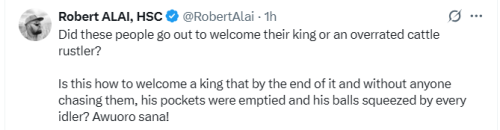
Gachagua’s landing, however, was met with sharp criticism from blogger and Kileleshwa MCA Robert Alai, who ridiculed how the homecoming unfolded. In a scathing post on his X account posted on Friday, August 22, 2025, Alai dismissed the scenes around Gachagua’s reception as embarrassing and unbefitting of a leader who once held the second-highest office in the country.
“Did these people go out to welcome their king or an overrated cattle rustler?” Alai posed, questioning the motives and organisation behind the chaotic scenes that accompanied Gachagua’s return.
Alai went further to paint a vivid picture of what he termed a humiliating spectacle. “Is this how to welcome a king that by the end of it, and without anyone chasing them, his pockets were emptied and his balls squeezed by every idler? Awuoro sana!” he added.
You Might Also Like


His remarks have since sparked debate online, with supporters of the former Deputy President defending the turnout as a show of loyalty, while critics argue that it exposed the desperation and disorganisation within Gachagua’s political camp.
The by-elections expected in various parts of the country in the coming weeks are seen as a critical test for political influence, with leaders positioning themselves ahead of the broader 2027 succession politics. Gachagua’s decision to abandon his extended stay in the US highlights the weight of the contests and the stakes involved for his political standing.
Alai’s words fit into a larger narrative of growing scrutiny around Gachagua’s political moves since leaving office. His trip abroad had been framed as a period of reflection and outreach to the Kenyan diaspora, but the urgency to return in the middle of it underscores the shifting dynamics at home.
By using such sharp and provocative language, Alai not only amplified the conversation around Gachagua’s welcome but also underscored the polarised state of Kenyan politics, where symbolism, optics, and perception weigh heavily on a leader’s relevance.
The clash of interpretations surrounding the homecoming leaves one clear impression: Gachagua’s political path remains contentious, with every move he makes bound to draw both loyalty and ridicule in equal measure.
Author
Latest News






Advertisement
More on Inside Politics