Advertisement
ODM breaks silence after Political Parties Tribunal rule on Sifuna fiasco
Friday 19th June, 2026 12:02 PM|

The Orange Democratic Movement (ODM) has issued a detailed clarification following the Political Parties Disputes Tribunal (PPDT) ruling regarding disciplinary proceedings initiated against its secretary general, Senator Edwin Sifuna, marking a significant development in an internal party dispute that has unfolded since February 2026.
According to the statement released by ODM’s executive director on Thursday, June 18, 2026, Oduor Ong’wen, the party’s National Executive Committee (NEC), initiated disciplinary proceedings on 11 February 2026, seeking the removal of Senator Sifuna from his position as secretary general.
“Today’s judgement is a significant reaffirmation of the doctrine of exhaustion, which requires parties to first exhaust available internal dispute resolution mechanisms before seeking the intervention of external adjudicative bodies,” ODM’s statement read in part.
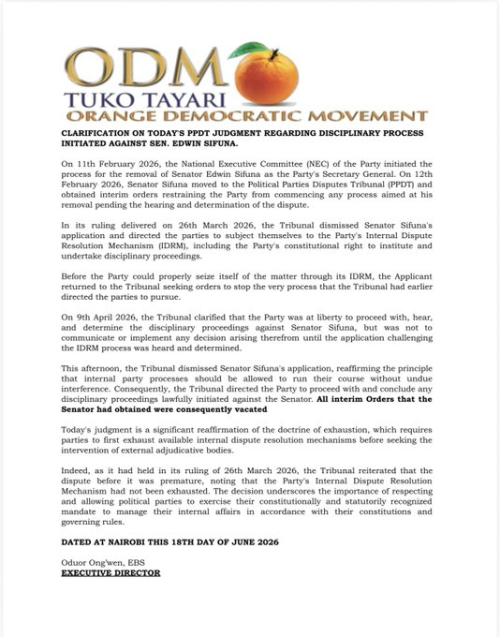
However, just a day after the process began, Sifuna moved to the Political Parties Disputes Tribunal (PPDT), securing interim orders that restrained the party from proceeding with the disciplinary action pending the determination of the dispute.
Tribunal’s initial rulings
You Might Also Like



In its ruling on 26 March 2026, the PPDT dismissed Sifuna’s application and directed all parties to first exhaust ODM’s Internal Dispute Resolution Mechanism (IDRM), affirming the party’s constitutional authority to manage its internal disciplinary processes.
The tribunal emphasised that political parties have the right to institute and conduct disciplinary proceedings under their constitutions, provided due process is followed.
Despite this direction, the dispute returned to the tribunal before the party had fully activated its internal mechanisms, with Sifuna seeking further orders to halt the process.
Clarification on party autonomy
On 9 April 2026, the tribunal clarified that ODM was at liberty to proceed with, hear, and determine the disciplinary case against Sifuna through its internal structures. However, it ordered that any resulting decisions not be communicated or implemented until the related application challenging the IDRM process was heard and concluded.
The tribunal further directed ODM to proceed and conclude any disciplinary proceedings lawfully initiated against the senator. Importantly, all interim orders previously obtained by Sifuna were vacated.

The tribunal’s ruling strongly reinforces the doctrine of exhaustion, which requires parties to fully utilise internal dispute resolution channels before seeking intervention from external adjudicative bodies.
It also reiterated that the IDRM process within political parties must be respected as long as it is constitutionally grounded and properly exercised.
What ruling mean for ODM
The decision effectively restores ODM’s authority to proceed with its internal disciplinary case against Senator Sifuna. It also sets a broader precedent, reinforcing political party autonomy in managing internal leadership and disciplinary matters.
As ODM moves forward, the outcome of the internal process could have significant implications for the party’s leadership dynamics and cohesion heading into a politically sensitive period.
Author
Latest News








Advertisement
More on Inside Politics