Advertisement
How Ruto is courting elected allies to bolster his reelection bid
Tuesday 03rd March, 2026 06:39 AM|

President William Ruto has intensified efforts to consolidate support among elected leaders as he lays the groundwork for his 2027 re-election bid, even as opposition politicos maintain they will make him a one-term President.
Across the country, a majority of governors, senators, members of Parliament and ward representatives remain aligned with his administration, even in regions that have recently shown signs of political restlessness, such as Mt Kenya and Western Kenya.
In public forums and development tours, these leaders have maintained visible support for the government. They frequently accompany the President during project launches and community engagements, projecting an image of unity and continuity.
Their presence signals an organised political base that could prove decisive as the next election cycle approaches.

You Might Also Like
At the same time, the ruling United Democratic Alliance (UDA) is attracting a large number of aspirants seeking to contest various seats on its ticket.
The influx of new hopefuls, combined with sitting leaders who already control established grassroots networks, is expected to shape the political landscape in Ruto’s favour.
Elected leaders often wield significant influence in their constituencies, coordinating campaign structures and mobilising voters at the local level.
Ruto successfully used a similar strategy in the 2022 election, relying heavily on alliances with local leaders to sustain his campaign machinery across different regions, particularly in the vote-rich Mt Kenya region. Many of those who backed him then later joined the administration or remained closely aligned with the government. That region remains central to his political calculus.

Move to regain turf
Last weekend, the President turned his attention to internal wrangles in Kiambu County, where leaders elected on the UDA ticket have been embroiled in public disputes.
Speaking on February 26, 2026, in Ruiru, Ruto urged them to resolve their differences and focus on service delivery. He framed unity as essential to both governance and electoral success.
“I will not accept the delivery of work in Kiambu to go wrong when we have been elected as the UDA party from the MCA position all the way to the governor. When the work of UDA is going wrong, where are we? And then we start blaming each other,” he said.

While he still commands the backing of most area leaders, there are notable exceptions. In Kiambu, Senator Karungo wa Thangw’a and Governor Kimani Wamatangi have signalled lukewarm engagement with the President’s camp.
However, Ruto has also managed to reclaim some ground. Githunguri MP Gathoni wa Muchomba and Juja MP George Koimburi, who had earlier associated themselves with former Deputy President Rigathi Gachagua, have since returned to the President’s fold.
“Yangu ni three term ya rais ni two term twende kazi! Kazi bila kelele. Yeah, I have decided this year I want maendeleo na kazi, siasa tutapiga baadaye. Na niko nyumbani niko State House kwa UDA,” Wamuchomba declared.
Slippery ground?
Across the wider Mt Kenya region, opposition to the government has grown among sections of the public, largely driven by economic concerns.
Even so, most legislators and governors have continued to cooperate with the President. In Murang’a County, the majority of elected leaders remain supportive, save for Senator Joe Nyutu and Gatanga MP Edward Muriu.
In Nyeri, only a handful of leaders, including Mukurweini MP John Kaguchia and Tetu MP Geoffrey Wandeto, are openly leaning toward Gachagua’s camp, while Governor Mutahi Kahiga has expressed conditional support for the President.
The backing of elected leaders has, however, placed them squarely in the crosshairs of the opposition.
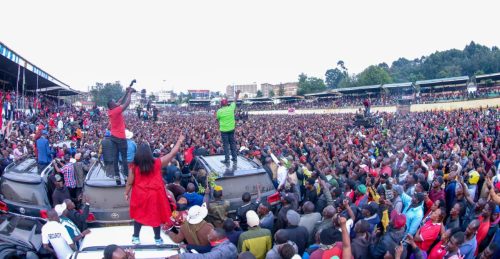
The United Alternative Government bigwigs have argued that public dissatisfaction over the high cost of living and other economic challenges should translate into political change at the ballot.
Gachagua has been particularly vocal in criticising pro-Ruto leaders in the Mt Kenya region. During recent tours of Kisii, Nyamira and Nakuru counties, he accused some of betraying voters by supporting the President and urged residents to reject them in the next election. Among those targeted were Nyaribari Chache MP Zaheer Jhanda, Governor Susan Kihika and Senator Tabitha Karanja.
“Mimi nataka tukubaliane; ndio mimi niende nitembeze Matiang’i Mlimani aende akutane na his cousin. Ndiyo watu wa Mlima wamuheshimu, lazima aheshimike hapa nyumbani. Sitaki mkubali watoto wadogo wakuje watusi Matiang’i, the DCP Pary chief said.
“In Nakuru, we have all the tribes in Kenya and all-important political decisions are made in Nakuru. When Nakuru decides it is one term, then indeed it is. I want to urge the people of Nakuru not to elect Susan Kihika for a second term.”
Now is the game of wait and see if Ruto’s strategy will work as his reelection faces an empirical test with the opposition politicos beefing up their camp to unseat him in the 2027 showdown.
Author
Latest News


Advertisement
More on Inside Politics