Advertisement
Safaricom explains possible cause of delayed M-PESA messages after complaints
Saturday 13th June, 2026 11:54 AM|

Safaricom has responded to concerns raised by customers over delayed M-PESA transaction messages.
Over the past few days, a section of M-PESA customers have been taking to social media to complain over what they claim to be a delay in relaying transaction messages after making a payment.
The telco has, however, clarified that the issue may not necessarily be linked to its systems but could instead be caused by users’ mobile devices.
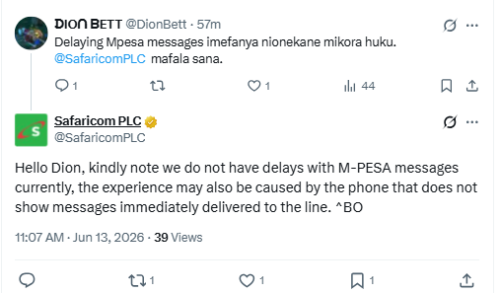
The telecommunications giant issued the clarification on Saturday, June 13, 2026, after an X user identified as Dion Bett complained about delays in receiving M-PESA notifications, claiming the experience had caused him embarrassment.
You Might Also Like



“Delaying Mpesa messages imefanya nionekane mikora huku. @SafaricomPLC mafala sana,” the user posted on the social media platform.
Device-related issues
In response, Safaricom denied experiencing any current system-wide delays affecting M-PESA messages.
According to the company, some delayed notifications may be linked to handset settings, software issues, or device-specific factors that prevent messages from appearing immediately after they are delivered to a customer’s SIM card.
“Hello Dion, kindly note we do not have delays with M-PESA messages currently, the experience may also be caused by the phone that does not show messages immediately delivered to the line,” Safaricom responded.
The clarification suggests that while the M-PESA transaction may be processed successfully and the confirmation message sent by Safaricom’s systems, the recipient’s phone may not display the notification instantly.
Such delays can sometimes occur due to poor network reception, phone memory limitations, battery optimisation settings, messaging application issues, or software-related glitches.
Growing reliance on M-PESA
The concerns come at a time when M-PESA remains Kenya’s most widely used mobile money platform, processing millions of transactions daily across the country.
Many businesses and individuals rely on instant transaction notifications as proof of payment, making delayed messages a source of frustration for customers.
In some cases, delays in receiving confirmation messages can lead to disputes between buyers and sellers, especially where proof of payment is required before goods or services are released.
Author
Mustafa Juma
View all posts by Mustafa JumaLatest News







Advertisement
More on Business