Advertisement
LSK tells employers to restore Ksh200 monthly NSSF rate or face legal liability
Saturday 13th June, 2026 09:38 AM|

The Law Society of Kenya (LSK) has warned employers against implementing revised National Social Security Fund (NSSF) contribution rates, insisting that they must revert to the previous statutory deduction of Ksh200 per month unless employees give consent or a court order suspending the earlier legal position is set aside.
LSK President Charles Kanjama, in a statement issued via his official X account on Saturday, June 13, 2026, said employers who continue applying the contested NSSF rates risk exposing themselves to legal liability, including claims for unlawful salary deductions.
He emphasised that court orders remain binding until they are formally overturned, warning that selective compliance with judicial decisions could create legal confusion and undermine the rule of law.
Kanjama stated that employers are not at liberty to choose which NSSF contribution framework to apply where a court has already declared a legal position unconstitutional or where its implementation has been suspended through judicial proceedings.
You Might Also Like



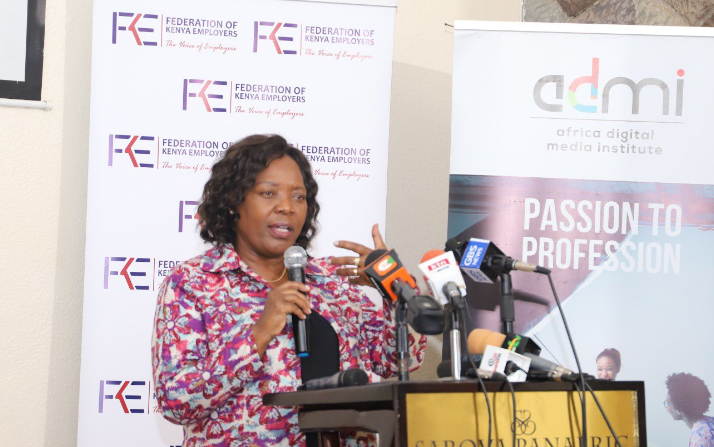
Kanjama’s remarks come hours after the Federation of Kenya Employers (FKE) advised employers to continue remitting NSSF contributions at the current statutory rates, despite the latest Court of Appeal ruling.
In a statement on June 12, FKE stated that employers can continue deducting and remitting the revised rates provided under the NSSF Act, 2013, while maintaining proper records and documentation to demonstrate compliance undertaken in good faith pending the final court decision.
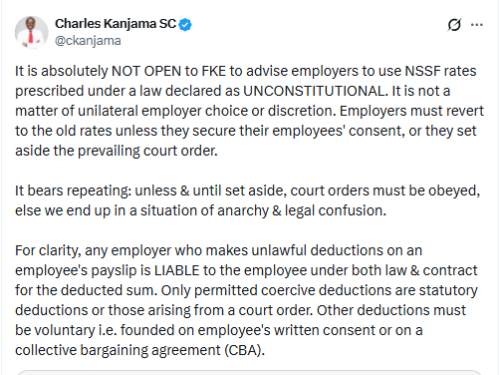
However, Kanjama has cautioned that any deductions made outside statutory authorisation or without employee consent amount to unlawful deductions under employment and contract law.
According to him, only three categories of payroll deductions are legally permissible: statutory deductions, court-ordered deductions, or voluntary deductions backed by written employee consent or collective bargaining agreements.
“It is absolutely NOT OPEN to FKE to advise employers to use NSSF rates prescribed under a law declared as UNCONSTITUTIONAL. It is not a matter of unilateral employer choice or discretion. Employers must revert to the old rates unless they secure their employees’ consent, or they set aside the prevailing court order,” Kanjama stated.
“It bears repeating: unless & until set aside, court orders must be obeyed, else we end up in a situation of anarchy & legal confusion,” he added.
Liability for unlawful deductions
Kanjama warned that employers who deduct money under the disputed rates without legal backing could be compelled to refund the amounts in court.
“For clarity, any employer who makes unlawful deductions on an employee’s payslip is LIABLE to the employee under both law & contract for the deducted sum. Only permitted coercive deductions are statutory deductions or those arising from a court order. Other deductions must be voluntary i.e. founded on employee’s written consent or on a collective bargaining agreement (CBA),” he said.
He added that employers risk not only financial exposure but also potential legal disputes with employees and regulatory scrutiny if they proceed contrary to the law.
Legal uncertainty over NSSF rates
The statement comes amid ongoing legal and policy uncertainty surrounding revised NSSF contribution structures, which have faced court challenges and competing interpretations on implementation.
At the center of the dispute is whether employers should continue applying the newer contribution framework or revert to the previous flat-rate system pending final judicial determination.
FKE has called on the Court of Appeal to expedite the determination of the matter to provide clarity and restore stability in the labour sector.
The federation noted that since the Court of Appeal has not yet issued a final determination in the matter, employers face uncertainty over whether to apply the revised NSSF rates under the 2013 Act or revert to the earlier capped contributions of KSh 200 per contributor per month.
COTU’s stand
The Central Organisation of Trade Unions (COTU-K) has defended the continued deduction and remittance of NSSF contributions under the current enhanced rates, saying workers and employers must remain compliant despite ongoing legal uncertainty surrounding the NSSF Act, 2013.

In a statement issued on Saturday, June 6, 2026, COTU said Kenyan workers will continue contributing under the framework set out in the NSSF Act, 2013, which it insists remains valid following earlier Court of Appeal directions.
“As the umbrella body representing Kenyan workers, we wish to inform the public that, as Kenyan workers, we shall continue contributing under the enhanced contribution framework provided for under the NSSF Act, 2013, which, in our view, remains valid and enforceable by dint of the judgement delivered by the Court of Appeal on 3rd February, 2023,” the union said through Secretary General Francis Atwoli.
The uncertainty comes after renewed debate triggered by a Court of Appeal decision delivered on May 29, 2026, which declined to suspend an earlier judgement that had declared parts of the NSSF Act, 2013, unconstitutional.
Author
Mustafa Juma
View all posts by Mustafa JumaLatest News





Advertisement
More on News