Advertisement
Kenya’s debt clock is ticking as every billion borrowed has hidden price tag – report
Friday 12th June, 2026 11:43 PM|

World Bank warns that rising government borrowing is pushing up interest rates, squeezing development budgets, and threatening Kenya’s fiscal future, even as Treasury admits the country is trapped between expensive external loans and a domestic market it cannot afford to flood.
Kenya is caught in a debt spiral that is getting costlier by the day, according to the World Bank’s Global Economic Prospects report released on June 11, 2026, and the Treasury Cabinet Secretary is not disputing it.
The central warning is stark: rising government debt does not just accumulate; it actively makes future borrowing more expensive. Aggregate government debt across EMDEs has surged from less than 40 per cent of GDP in 2010 to over 70 percent today.
In that same period, debt-service costs have nearly doubled, from 6 per cent of government revenues in 2010 to an estimated 11 percent in 2025.
You Might Also Like

“Mounting debt-service payments pose four critical challenges. They divert resources from infrastructure, health, and education; force governments to borrow more simply to service existing loans; drive up the economy-wide cost of capital; and, if left unchecked, can trigger debt distress, default, and severe economic disruption,” the report states.
What makes the World Bank’s analysis especially alarming for Kenya is the report’s finding on the non-linear relationship between debt and interest rates. This is not a simple, predictable curve; it accelerates.
When a country’s debt is around 45 per cent of GDP, a one-percentage-point increase in the debt-to-GDP ratio raises sovereign spreads by roughly 8 basis points.
But when debt climbs to around 80 per cent of GDP, the same one-percentage-point increase adds approximately 26 basis points to borrowing costs. In plain terms, the more you owe, the more each new shilling of debt costs you.
Between 2010 and 2024, the World Bank estimates that the median EMDE debt increase contributed 114 basis points to sovereign spreads and 31 basis points to domestic-currency yields.
That is not an abstraction; it is the difference between a government that can fund hospitals and roads and one that is feeding a debt machine.

Treasury admits the bind
Treasury Cabinet Secretary John Mbadi has acknowledged the country is navigating exactly this terrain.
“Deficit can only be financed through borrowing, both domestic and external,” he said on Thursday, June 11, 2026, ahead of the 2026/27 budget presentation in Parliament, adding that global financial conditions are increasingly unfavourable.
“External borrowing is not very certain. We are not getting concessional loans easily because Kenya is now seen as a developing economy with the capacity to access commercial funding. But the macro environment globally is not good; high inflation, disruptions, and shocks mean investors are asking for more money,” Mbadi said.
“When you come to domestic borrowing, you crowd out the private sector and interest rates start rising,” he warned.

The World Bank’s data backs him up precisely: its research shows that domestic-currency bond yields rise by 2 to 8 basis points for every one-percentage-point increase in debt, depending on the starting debt level.
The Treasury has projected approximately Ksh116 billion in external borrowing to finance 2026/27 expenditures and development projects, with the remainder to come from domestic sources, a financing mix that carries significant fiscal risk on both fronts.
The most politically explosive implication of the World Bank’s analysis is what high debt does to ordinary Kenyans. Every additional billion shillings spent servicing debt is a billion not spent on roads, schools, or hospitals.
“Rising debt-service obligations may divert government resources from other priority uses such as investment in infrastructure, health and education, and support for social safety nets,” the report notes.
This diversion also undermines the public investment, services, and reforms needed to raise productivity and support job creation.
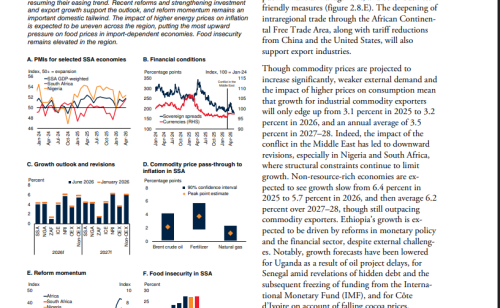
For Sub-Saharan Africa, where Kenya’s growth forecast has been revised down 0.5 percentage points to 4.4 per cent for 2026.
“High borrowing costs, reduced concessional financing, and declining official development assistance are set to add to fiscal challenges,” the report warns.
The Eurobond overhang
Kenya’s vulnerability is sharpened by its exposure to commercial external debt. The World Bank’s report flags that EMDEs with weaker credit ratings experienced much larger increases in spreads when global interest rates rose, a dynamic Kenya encountered painfully during its recent Eurobond repayments, when it was forced to refinance at significantly higher rates.
“A history of default, low credit ratings, frontier market status, heavy reliance on short-term debt, and weak governance,” it observes.
Kenya, classified as a frontier market, sits squarely in the higher-risk category where the debt-interest-rate spiral turns fastest.
The World Bank is not without prescriptions. It calls for stronger domestic revenue mobilisation, more efficient public spending, improved debt management, and support for domestic debt market development.
Where feasible, debt-for-development swaps, which replace existing sovereign debt with financing tied to development outcomes, could create fiscal space while supporting sustainability.
Mbadi offered a cautious note of optimism, hinting that ongoing negotiations with a financial partner could ease pressure on the local market.
“I will tell you, we are a bit lucky that our discussion with one bank is progressing well. If that happens, it will ease the domestic burden,” he said.
At much higher debt levels, fiscal consolidation becomes essential to contain borrowing costs, generate fiscal savings, and create space for private investment.
The question is whether the country can build fiscal space faster than the interest rate rises.
Author
Latest News







Advertisement
More on Business