Advertisement
Kenya faces growth test as World Bank predicts tough years for developing economies
Saturday 13th June, 2026 12:30 AM|

Kenya faces a major economic test as the World Bank warns that developing economies could struggle to close the income gap in the years ahead, raising fears that millions of young people may enter adulthood without seeing the prosperity expected from decades of growth.
The warning comes as the World Bank’s Global Economic Prospects June 2026 report reveals a slowdown in developing economies, pointing to weaker growth, rising pressures on households and challenges in creating enough jobs for a rapidly expanding workforce.
The big question for Kenya is becoming increasingly personal: Will the next generation be richer than the current one?
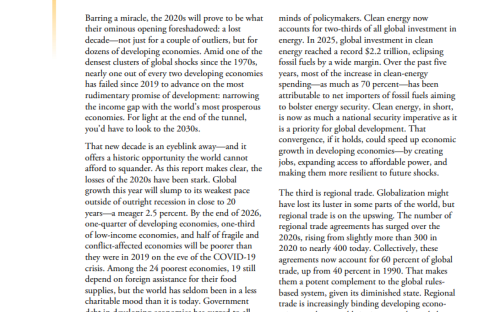
The World Bank says many emerging market and developing economies (EMDEs) risk falling further behind advanced economies, with slower income growth threatening progress made over previous decades.
You Might Also Like



“EMDEs excluding China and India are facing almost a full decade of lost convergence with advanced economy income levels,” the World Bank says.
For Kenya, the warning comes at a time when households are already feeling the pressure of high living costs, expensive credit, unemployment concerns, and a difficult business environment.
The country has maintained steady economic activity compared with many peers. Still, growth has not always translated into enough quality jobs, especially for young people entering the labour market every year.
The youth employment challenge
Kenya’s biggest economic challenge may not only be growth but whether growth creates enough opportunities.
The World Bank estimates that 1.2 billion young people globally will reach working age by 2035, creating a huge demand for jobs in developing countries.
For Kenya, where millions of young people join the workforce annually, the pressure is already visible.
Many graduates continue searching for employment while businesses struggle with high operating costs and limited access to affordable financing.

The question facing policymakers is whether the economy can create enough productive jobs before the next wave of workers arrives.
“EMDEs face a major jobs challenge as 1.2 billion young people are expected to reach working age by 2035,” the report states.
The World Bank’s warning comes as global shocks continue affecting economies.
The report says global growth is slowing because of higher energy prices, inflation pressures, tighter financial conditions and weaker trade prospects.
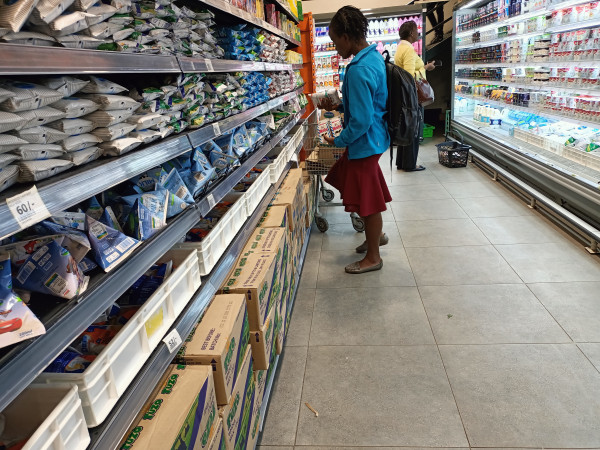
For Kenyan families, this can translate into higher costs for fuel, food, transport and household goods.
When global oil prices rise, Kenya’s import bill increases because the country relies heavily on imported petroleum products. Higher energy costs affect nearly every part of the economy, from farmers using machinery to traders transporting goods.
The World Bank warns that weaker growth combined with inflation pressures could make it harder for governments to support households.
“Weaker growth prospects, combined with constrained fiscal space… are widening existing development gaps and exacerbating food insecurity and poverty.”
The productivity problem
Experts say Kenya’s future growth will depend on whether the country can increase productivity by producing more value from workers, technology and investment.

The World Bank notes that global productivity growth has slowed and that artificial intelligence could become a major factor shaping future economic performance.
However, countries without strong digital infrastructure, skills and institutions risk missing the benefits of new technology.
“Economies that lack the physical, digital and institutional foundations needed to benefit from AI risk being left behind.”
For Kenya, this puts focus on digital skills, innovation, education reform and supporting industries that can absorb young workers.
Can East Africa avoid the growth trap?
Across the East African Community (EAC), governments are betting on regional trade, infrastructure and integration to drive future growth.
A stronger regional market could help businesses expand beyond national borders, improve exports and attract investment.
But the World Bank says countries must strengthen the foundations of growth, including infrastructure, human capital and private investment.
Author
Latest News





Advertisement
More on Business